
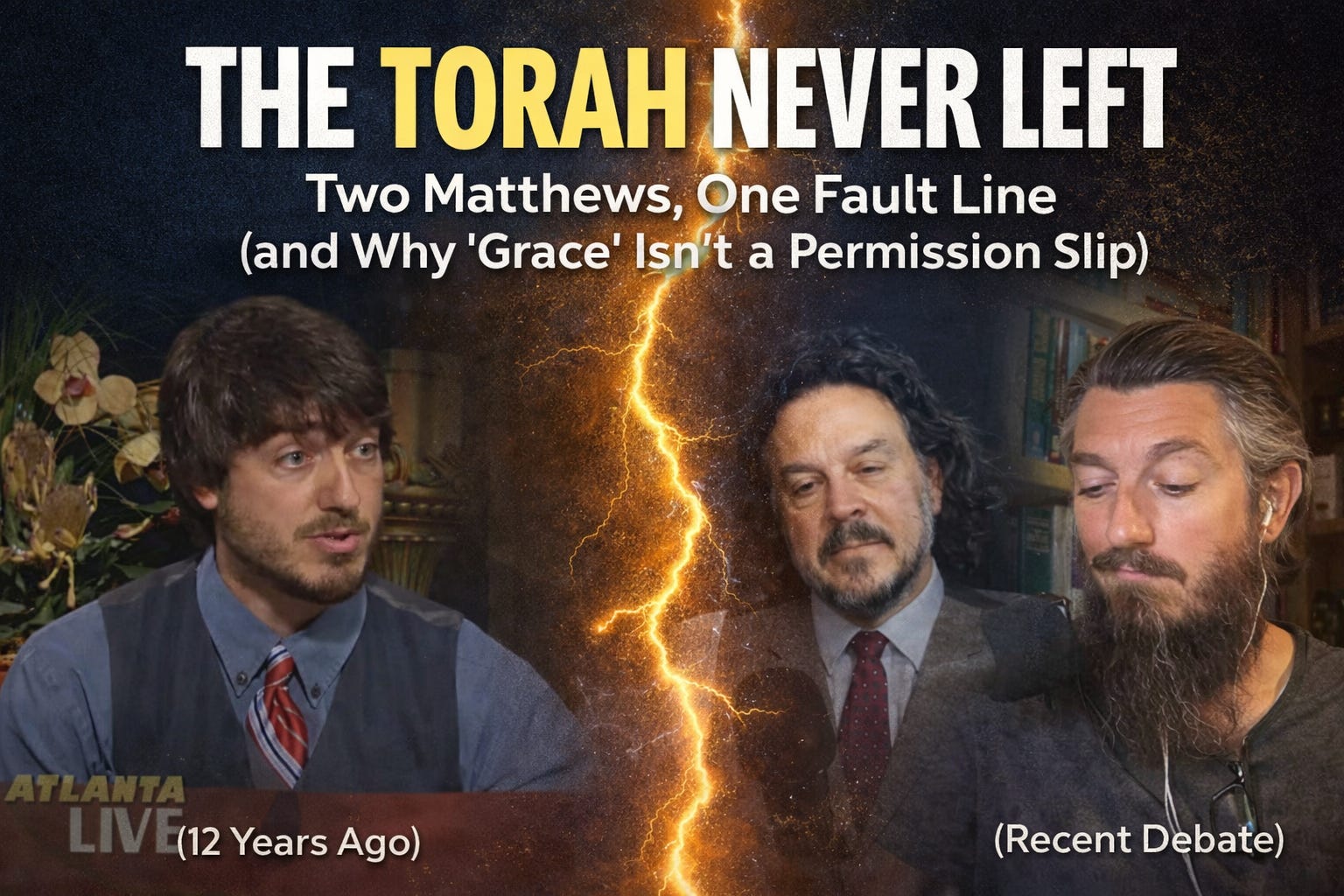
Two Matthews, One Fault Line (and Why ‘Grace’ Isn’t a Permission Slip)
My YouTube Video | Matthew’s Video | Transcript | Live Debate on Matt 5:17–20 — Pastor Matthew Janzen vs. Prof. R. L. Solberg
Most Christian arguments about “law vs. grace” begin with a quiet assumption: that the Torah was a temporary scaffold God used until Jesus arrived; useful once, then politely discarded. But what if that assumption is the very thing that keeps us stuck in the same loop of prooftexts, hot takes, and theological shadowboxing?
In a recent debate between Torah-observant pastor Matthew Janzen and Professor Solberg, the question wasn’t whether obedience matters (both agree it does), but whether the kind of obedience Yeshua embodied: Sabbath, clean living, covenant rhythms, and the whole “jot-and-tittle” worldview, still has any claim on disciples living in the modern dispersion.
This is where things get interesting. Because the debate isn’t really about a list of rules – it’s about what it means to be a disciple, what “fulfillment” actually means in Matthew 5, and whether the “law and the prophets” are a dusty museum wing of the faith or the living constitution of the Kingdom. One side reads Jesus as the climax that closes the Torah chapter; the other reads Jesus as the Rabbi who teaches Torah rightly, calling His students to walk as He walked.
And once you see the fault line clearly, you can’t unsee it: either Torah is eternal instruction that Messiah internalizes and empowers, or it’s a covenant artifact that got filed away when the new covenant arrived. Let’s sharpen the terms, read the text like first-century Jews would, and ask the question modern Christianity keeps dodging – what if Jesus didn’t come to end the Law, but to put it back in our mouths?
1) Matthew frames Matthew 5 as a discipleship & behavior sermon
His foundation is that Matthew 5–7 is primarily instruction for how to live, not a prooftext about Messiah ending Torah.
- Beatitudes → salt/light → “let your light shine… good works” → then Torah statement (5:17–20).
- Therefore he reads 5:17–20 as ethical direction for disciples, not merely prophecy talk.
Present-day implication: If you call yourself a disciple, you should actively pattern your life after Yeshua’s Torah-walk.
2) “Fulfill” = active obedience + right teaching, not “abolish by completing”
This is one of his most repeated points:
- He argues plērosai in Matt 5:17 is active (“do/bring to full practice”), like Matt 3:15 (“fulfill all righteousness”).
- He contrasts that with Matthew’s “prophecy fulfillment” formula elsewhere (passive “fulfilled” language), arguing Matt 5:17 isn’t that category.
Present-day implication: “Fulfill Torah” = do and teach it, i.e., disciples imitate Messiah’s way of walking it out.
3) “Law and Prophets” = Torah + prophetic preaching calling Israel back to Torah
He rejects the “Law and Prophets = whole Tanakh shorthand” as the controlling meaning in this passage and argues instead:
- Prophets function as preachers of Torah obedience, not “a bucket of messianic predictions.”
- He cites parallels like Daniel 9:10 and 2 Kings 17:13 (prophets calling back to commandments).
Present-day implication: Disciples should hear Torah through the same lens as the prophets: return/repent/obey.
4) Jot/tittle + heaven/earth = maximal durability language
He reads Matt 5:18 very straightforwardly:
- “Not one jot or tittle passes… until heaven and earth pass.”
- Therefore Torah’s authority continues through the present age.
He also links it to the Jewish/high view of Torah as enduring (“incorruptible light,” “law endures forever”) and says Yeshua is echoing that stream.
Present-day implication: You don’t treat Torah as “old/expired,” but as still authoritative—even in exile-like conditions.
5) Dispersion doesn’t abolish Torah; it creates “out-of-gear” constraints
This is his “exile precedent” argument:
- Daniel and other exiles couldn’t keep everything (no Temple), but still kept Torah “as able.”
- Lack of ability ≠ abolition (his blind/tassels analogy).
Present-day implication: In dispersion we obey what we can, and where we can’t (Temple-dependent commands), we don’t declare Torah void—we recognize circumstance.
6) Practical Torah today: he lists “keepable commandments” as a measuring rod
He repeatedly emphasizes present applicability via examples you can do now:
- Sabbath rest
- clean meats / no blood
- tassels
- no wool/linen mix
- Yom Kippur fasting
- unleavened bread during Passover
- sexual purity laws (e.g., niddah)
- etc.
His rhetorical move: “If you can do it, it’s for you.”
Present-day implication: Torah-observance is tangible and embodied, not just “principles.”
7) “Greater righteousness than Pharisees” = better Torah-keeping (heart + deed)
He argues Matt 5:20 is about practical righteousness, not only imputed righteousness:
- Antitheses show Torah “done rightly” (anger = murder-seed, lust = adultery-seed, reconciliation, etc.).
- He connects 5:20 to 6:1 (“beware of doing your righteousness before men”)—righteousness is actions (giving, prayer, fasting).
Present-day implication: Torah isn’t reduced to external checklists; it’s deeper, heart-rooted obedience.
8) Works aren’t “earning salvation,” but covenant loyalty is required to inherit life
He pushes back on “works righteousness” framing by saying:
- True faith produces faithfulness; lack of works reveals a dead/stone heart.
- He uses marriage language: not perfect, but faithful.
- He says “least in the kingdom” still implies entry for some failures, but warns “great commandments” violations may exclude (he specifically flags Sabbath as weighty).
Present-day implication: He urges serious covenant allegiance, not antinomian complacency, while still affirming Messiah’s saving work.
9) Great Commission = teach “everything Yeshua commanded” = includes Torah
He claims a direct line:
- Matt 5:17–19 (“do and teach commandments”)
- Matt 28:19–20 (“teach them to observe all I commanded”)
Present-day implication: Torah instruction is part of discipling the nations, not merely optional Jewish practice.
10) He frames the debate as: “Do you want to be like Jesus?”
His emotional center is imitation:
- Luke 6:40 (“disciple… like teacher”)
- 1 John 2:6 (“walk as He walked”)
- “Christian = follower of Messiah.”
Present-day implication: In dispersion, the core motivation is identity: imitate Messiah’s way of life.
What a “live it out in dispersion” Matt-Janzen playbook looks like (as implied by his argument)
- Obey what you can obey now (Sabbath, food, calendar rhythms, ethical Torah, etc.).
- Don’t declare Temple commands abolished—treat them as presently non-executable but still Torah.
- Interpret Yeshua’s teaching as intensifying Torah, not replacing it.
- See obedience as covenant loyalty flowing from faith, not “earning points,” but also not optional.
- Disciple others into the same: practice + teach.
22.) Video | Transcript | Loving Yahweh’s Law (Atlanta Live Interview)
Here are the top 10 key ideas Matthew Janzen introduces in this TV interview (based on your transcript), focusing on his “Torah is eternal” / “New Covenant = Torah written on the heart” framework:
- Torah = “teaching/instruction,” not harsh bondage | He stresses that “law” (Torah) means teachings, instructions, guidance—a loving Father’s counsel meant for our good (he cites Deut 6 as “for our good”).
- God’s “fence” analogy: boundaries produce liberty, not oppression | Like a father keeping a child inside a fence to protect him from danger, Yah’s commands create safety and freedom, not harm.
- Love for Torah is biblical and recurring (OT → NT) | He strings together passages (Prov 3; Ps 119; John 14–15; 1 John 5:3) to argue that Scripture consistently portrays love for God as keeping His commandments.
- Law isn’t the enemy—sin is | He reframes the common mindset: it’s not Torah that opposes us; it’s our sin against Torah that condemns.
- Justification is by Messiah alone, not by Torah-keeping | He explicitly denies legalism: salvation/justification is solely because Yeshua lived sinless, died as the unblemished lamb, and rose—classic substitutionary atonement language (Isa 53 referenced).
- Obedience is “fruit,” not the “root” of justification | He uses Ezekiel 36 to argue that once God declares us righteous, He changes the heart and produces obedience as evidence and outcome.
- New Covenant defined as Torah written on heart and mind | He anchors “New Covenant” in Jeremiah 31 and Hebrews 8, emphasizing it’s not abolition but internalization—from stone tablets to heart/mind.
- Greatest commandments are “headings,” not replacements | On Mark 12 / Matthew 22: Love God + love neighbor are the framework under which all other commandments hang—he rejects the idea that it reduces Torah to only two laws.
- Matthew 5:17–19 as his core proof: Jesus didn’t destroy Torah | He argues the “fulfill” language means confirm/do/practice (he cites Greek plēroō), and that “jot and tittle” language implies Torah remains until heaven/earth pass and “all is accomplished.”
- Discipleship imitation: Messiah kept Torah perfectly, so believers should pursue obedience | He emphasizes Jesus kept the law perfectly (sinless lamb), and believers, by the Spirit, should strive to practice and teach even “small” commandments—while still needing grace.
- “Torah means teachings—instructions and guidance. It’s a Father teaching His children, not a thumb pushing us down.”
- “The fence brings liberty, not bondage. My child thinks it limits him, but I know it protects him.”
- “It’s not the law that’s against us—it’s our sin against the law.”
- “I’m not teaching justification by the law. We stand righteous before the Father solely because of the work of His Son.”
- “The new covenant is the law written on the heart and mind—no longer forced compliance, but willing obedience from a changed heart.”
Whether you watch Janzen in a 12-year-old TV studio calmly explaining Torah as a Father’s “fence” that protects freedom, or you hear him in debate mode pressing Matthew 5 with “jot-and-tittle” seriousness, the throughline is the same: Torah isn’t a relic – it’s a covenant blueprint meant to be loved, internalized, and lived.
The real argument isn’t whether obedience matters (everyone says it does); it’s whether Messiah’s work erases God’s instruction or writes it deeper – from heart of stone to heart of flesh, from mere compliance to covenant loyalty rooted in the love of Christ.
If grace is the rescue, Torah is the map for the rescued. And if Yeshua is truly the Rabbi we claim to follow, the uncomfortable question remains: are we using “fulfilled” as an exit ramp or a loophole as a way out of even trying to keep what applies to us… or as the beginning of an eternal life that finally makes sense under the King of Kings?