Hint: It Isn’t Heaven Or Hell!
Most modern Christians assume (because it’s often taught from the pulpit) that the dead go straight to “heaven or hell,” but the Bible’s language is far more precise – and far more consistent.
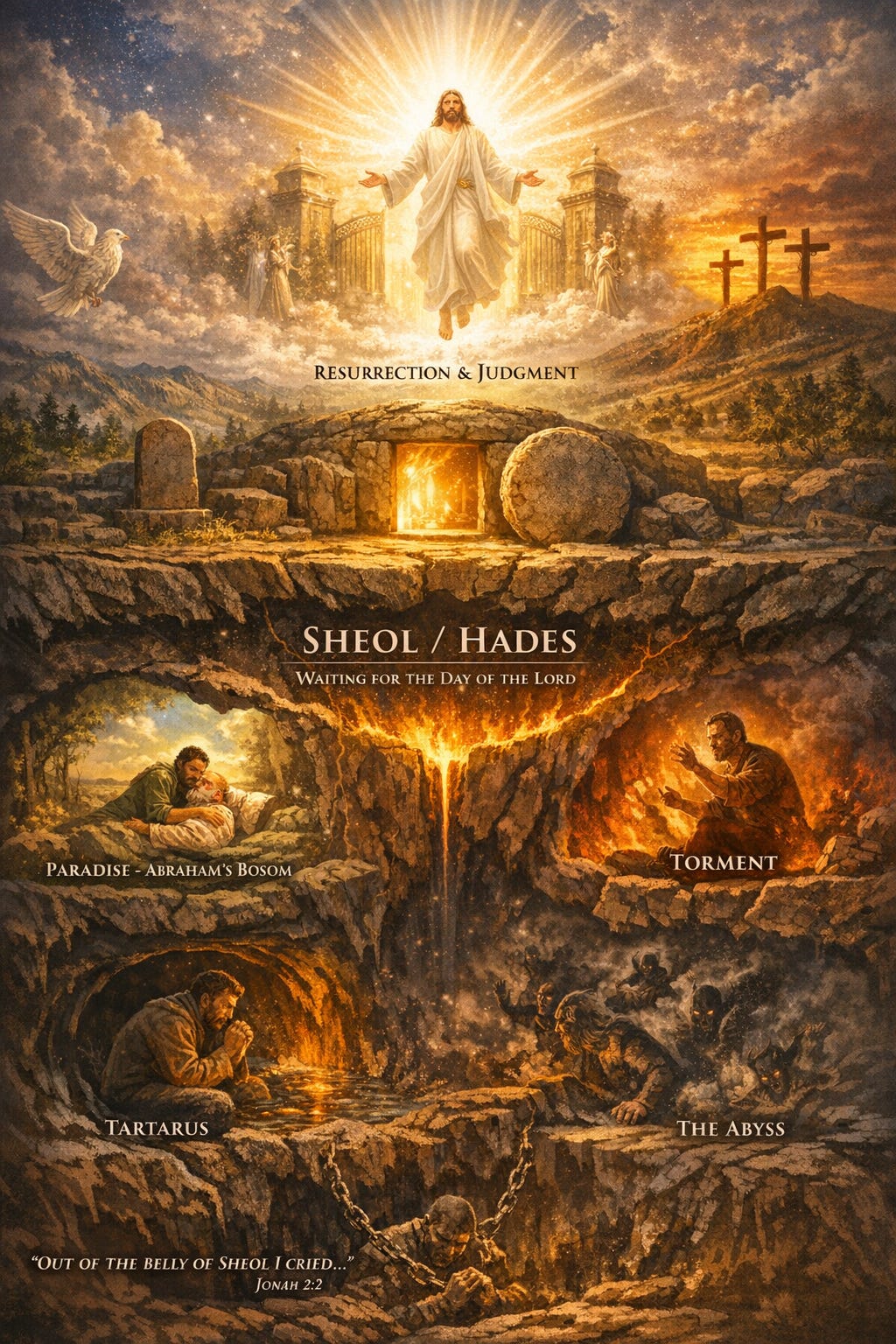
Scripture repeatedly describes an intermediate realm of the dead: Sheol (Hebrew) / Hades (Greek), a real “underworld” holding place where the dead await the final resurrection and judgment.
The Sheol & Gehenna series from Ministers of the New Covenant helps recover these categories: Sheol/Hades now, Gehenna (Lake of Fire) later – and it argues that “hell” language has often been flattened into a single, unbiblical bucket.
A major point of confusion in modern day churches is Jesus (Yeshua’s) promise to the criminal on the cross: “Assuredly, I say to you, today you will be with Me in Paradise” (Luke 23:43). But Greek manuscripts did not contain modern punctuation, and the comma is a translator insertion.
Read with the comma shifted – i.e., “Truly I say to you today, you will be with Me in Paradise”. In this readying, the statement harmonizes with the rest of Scripture: Yeshua did not ascend to heaven that day.
He would later tell Mary, after His resurrection, “I have not yet ascended to My Father” (John 20:17). Instead, Messiah descended to “the heart of the earth” (Matt 12:40), spending three days in the realm of the dead before being raised.
This is not a detour; it is central to the gospel: Messiah’s victory is not escape from death, but conquest of death – becoming the firstfruits of the resurrection harvest (1 Cor 15:20–23).
The Tanakh already supplies a prophetic pattern for this. Jonah, the sign Yeshua Himself points to, describes his experience in the fish as a descent into Sheol: “Out of the belly of Sheol I cried” (Jonah 2:2). Jonah’s “three days” becomes a living prophecy of Messiah’s own descent and deliverance.
The consistent biblical arc is this: the dead await, the righteous await vindication, and the wicked await judgment. Resurrection, not disembodied heaven-going, is the Bible’s promised hope.
Yeshua also gives a direct window into this unseen realm in Luke 16, in the account of the rich man and Lazarus. This is often dismissed as “just a parable,” but the details read like a description of a real place with real features: fixed separation, conscious awareness, and irreversible outcomes.
Lazarus is comforted while the rich man is tormented, separated by a “great gulf” that cannot be crossed (Luke 16:26). The series argues this maps cleanly to the “chambers” concept found in ancient Hebrew thought (and elaborated in 1 Enoch as a Second Temple witness): compartments of Sheol where souls await their final sentencing.
Whether one treats every “Enochic” detail as binding or not, the core biblical point stands: there is an interim realm, and the wicked who have passed on can experience torment now – not fire, but the horror of irreversible loss and the certainty of judgment ahead.
This article, then, is not an exercise in speculation; it’s a call to restore biblical categories:
- Gehenna/Lake of Fire is future.
- Sheol/Hades is present.
- The resurrection is the blessed hope.
Messiah’s descent into the heart of the earth, His resurrection as firstfruits, and His promise to raise His people at the last day re-center our eschatology where Scripture centers it: not in “going to heaven,” but in the coming Kingdom, the Day of the Lord, and the resurrection of the saints to inherit glorified bodies and who dwell, rule and reign with Messiah for ever.
If we misunderstand where the dead are, we will misunderstand what salvation is. The gospel isn’t “escape earth” – it’s death defeated, the Kingdom revealed, and the sons of God raised in glory.
This is the foundation we’ll build on in the references to the series listed below (for a FAR deeper dive into this topic, with many hours of content and research):
Ministers Of The New Covenant (youtube channel) | Sheol & Gehenna Series
- Sheol & Gehenna, Pt. 1-2 | video, transcript
- Sheol & Gehenna, Pt. 3 (Fallen Angels, Tartarus) | video, transcript
- Sheol & Gehenna, Pt. 4 (Chambers in Sheol) | video, transcript
- Sheol & Gehenna, Pt. 5” (More on Tartarus and the Abyss) | video, transcript
- Sheol & Gehenna, Pt. 6 (Review + Hades Definition) | video, transcript
- Sheol & Gehenna, Pt. 7 (4 Human Chambers, Sheol) | video, transcript
- Sheol & Gehenna, Pt. 8 (The Chamber of the Martyrs) | video, transcript
- Sheol & Gehenna, Pt. 9 (3 Q/A, 1 Enoch, Review Chambers) | video, transcript
- Sheol & Gehenna, Pt. 10 (1 Enoch Allusions, Rapha/Shades) | video, transcript
Below is a MECE (mutually exclusive, comprehensively exhaustive) study/report of the series’ claims and their biblical / 1 Enoch scaffolding, followed by a 10-part sermon-ready summary.
A Holistic Map Answering “Where Do People Go When They Die?”
A) Final destination (future, not currently occupied): Gehenna
Series claim: “Gehenna / Lake of Fire / Furnace of Fire” is future and currently unoccupied. It is not where anyone is “burning right now.”
Key exegetical anchor they use:
- Matthew 25:41 — “everlasting fire, prepared for the devil and his angels” (their point: Gehenna’s primary design intent was angelic judgment).
MECE implication:
Gehenna is not the intermediate state. It is the post-judgment, end-state.
B) Intermediate holding realm (under the earth): Sheol / Hades
Series claim: Sheol (Hebrew) ≈ Hades (Greek) ≈ “hell” (English term used inconsistently), and it contains multiple fixed chambers (no movement between chambers).
They emphasize “hell” as an English umbrella that masks different underlying terms (Sheol/Hades vs Gehenna vs Tartarus), which causes doctrinal confusion.
The Occupants: Who Goes Where?
A) Angelic prisoners: Tartarus (lowest Sheol/Hades)
Series claim: Tartarus is a distinct chamber associated with Genesis 6 / Watchers and explicitly linked to 2 Peter 2:4 (“cast them down to Tartarus”).
They argue:
- Angels are immortal (“cannot die”), so their punishment can be described as “everlasting fire” in a different sense than human mortality arguments.
They also integrate 1 Enoch’s Watchers framework (200 angels, leadership structure, etc.) as interpretive background for Genesis 6.
B) “Unclean spirits” prison: The Abyss / Abusos
Series claim: The “Abyss” is another chamber (distinct from Tartarus), associated with unclean spirits and Revelation imagery (smoke, locust-like entities, a king over them).
They connect:
- Revelation 9 (locusts from the abyss; “angel of the abyss” Abaddon/Apollyon; 5 months torment) as evidence the abyss is an active chamber with conscious entities.
They also tie in Jubilees/Enoch logic: spirits of dead giants become “unclean spirits,” with a portion confined and a portion remaining active on earth (they explicitly cite the “90% / 10%” idea as part of their framework).
C) Human dead: four “hollows / chambers”
This is where the series leans heavily on 1 Enoch 22 as a descriptive template:
- Four hollow places in a great mountain: “three dark, one illuminated,” with a “fountain of water” in the middle (their quoted Enoch 22 imagery).
They explicitly call these “pits for confinement” until the day of judgment when they are “extracted.”
MECE classification of the four human chambers in their presentation (as best reflected in the transcripts you provided):
- Righteous / illuminated chamber (they begin the human-chambers discussion with “Abel” as an occupant and use Abel’s “cry/suit” upward as proof of consciousness).
- A chamber associated with “martyrs / righteous cry” themes (they connect to Abel, and later to “how long” style passages; your later parts reinforce this direction).
- A “pain” chamber (they define a Hebrew verb tied to trembling/birth-pain imagery to argue graded suffering and consciousness in “human compartment #2”).
- A “godless companion with lawless” chamber (their Enoch 22 reading includes a chamber “created for… sinners who were godless… companions with the lawless,” and they say those spirits “will not be raised” (their reading/interpretation from Enoch 22).
Note: The series itself uses multiple names and overlapping descriptions (“hollows,” “pits,” “storehouses,” “chambers of the soul”). They also say “no movement between chambers,” which is part of their core structure.
Names & Synonyms: What Each Realm Is Called
A) Gehenna synonyms (they stress these)
- Gehenna
- Lake of Fire
- Furnace of Fire…and “outer darkness” as a related label in their rabbinic survey.
B) Human-chamber labels (their “six names” list)
They explicitly name several “Sheol chamber” labels pulled from Bible + apocrypha:
- “chambers of death” (Prov 7:27)
- “hollow places / cavities” (Enoch 22)
- “treasuries / storehouses of souls” (2 Baruch 30:2 as they cite it)
- “chambers of the soul” (they cite 2 Ezra 4:35–42 conceptually)
- “pits for confinement” (Enoch 22)
State of the Dead: Consciousness vs. Unconsciousness
Series claim: At minimum, many occupants are conscious in Sheol-chambers, because:
- The Watchers in Tartarus are “bound in chains,” implying ongoing experience and restraint (their inference).
- The abyss has conscious torment activity in Revelation 9 (locusts, king, torment duration).
- Enoch 22 depicts Abel’s spirit making “suit/complaint,” and Raphael explaining hollows as spirit confinement until judgment (their quotation).
They also stress: Gehenna is not where this is happening now—even if Sheol chambers are active, Gehenna is still future.
The Timeline, i.e. What Happens When?
Stage 1 — Death → Sheol/Hades (assigned chamber)
Human spirits go to a “holding” compartment (their model is heavily aligned to Enoch 22’s “until the day of judgment” language).
Stage 2 — Judgment / resurrection events
They repeatedly frame Sheol chambers as temporary confinement “until the day… of judgment” after which extraction occurs (they apply Enoch 22 this way).
Stage 3 — Final casting into Gehenna (Lake of Fire)
They cite the logic that “death and hell” are ultimately cast into the lake of fire (their language echoes Revelation 20’s sequence, even where not fully quoted in the snippets shown).
Holistic exegetical takeaways (the series’ “big claims”)
- Most Christians collapse three different words into one English “hell.” The series insists this is the root of confusion (Gehenna ≠ Hades/Sheol ≠ Tartarus).
- Gehenna is not the current destination of the dead. It’s future and empty now.
- Sheol/Hades is multi-compartmental, and the series uses both Tanakh hints (Proverbs 7:27 “chambers of death”) and apocryphal expansions (1 Enoch 22 “four hollows”) to build a chamber framework.
- Angelic punishment categories exist (Watchers → Tartarus; other spirits → abyss), and these categories are not interchangeable in their view.
- 1 Enoch is treated as essential interpretive background (they argue Jude quotes it; they cite DSS support; and they treat Enoch 22 as a “map” of Sheol’s internal divisions).
Ten Summary Statements From This Ten Part Series
Part 1–2 — “Why ‘Hell’ is a bad shortcut”
- Introduce the word-problem: English “hell” collapses Sheol/Hades/Gehenna/Tartarus.
- Establish: Gehenna is future and empty now; “worms/fire” language appears in multiple texts, but must be mapped to the right category.
Part 3 — Fallen Angels & Tartarus
- Tartarus as the “lowest” chamber for Watchers (Genesis 6 / 2 Peter 2:4).
- Stress: Gehenna prepared for “devil and his angels.”
Part 4 — “Chambers in Sheol”
- Move from angelic chambers to the concept of human chambers.
- Establish “no movement between chambers” as a structural claim.
Part 5 — “More on Tartarus and the Abyss”
- Abyss: Revelation 9 locusts, Abaddon/Apollyon, 5 months torment—evidence of conscious activity, not “unconscious sleep” in that compartment.
Part 6 — Review + Hades definition
- Clarify: Sheol/Hades is “underworld/under the earth” realm with compartments; Gehenna remains future.
- Tie in giant/unclean spirit origin claim (giant spirits → unclean spirits; Jubilees-style “10% remain” framework).
Part 7 — Four human chambers (Enoch 22 as template)
- Present the “four hollows” (3 dark, 1 illuminated; fountain of water; confinement until judgment).
Part 8 — Chamber of the Martyrs (and Abel as first witness)
- Abel’s spirit “making suit/crying” as a consciousness proof-text within their Enoch 22 framework.
Part 9 — Q&A + Enoch + chamber confirmations
- Reinforce: multiple sources (Torah/Prophets/Writings + apocrypha) point to compartmental language (“chambers,” “hollows,” “pits”).
Part 10 — Enoch allusions + “Rapha/Shades” + pain chamber
Stress the “birth-pain” style word study to describe suffering/consciousness in a human chamber, while maintaining: this is still Sheol, not Gehenna.