
My Thoughts and a Theory (LXX) Worth Testing
A group of Torah-observant Christian brothers recently walked through a provocative idea: what if the first Passover isn’t only a memorial of the Exodus, but also a prophetic template for the final deliverance, possibly even the timing of Messiah’s return?
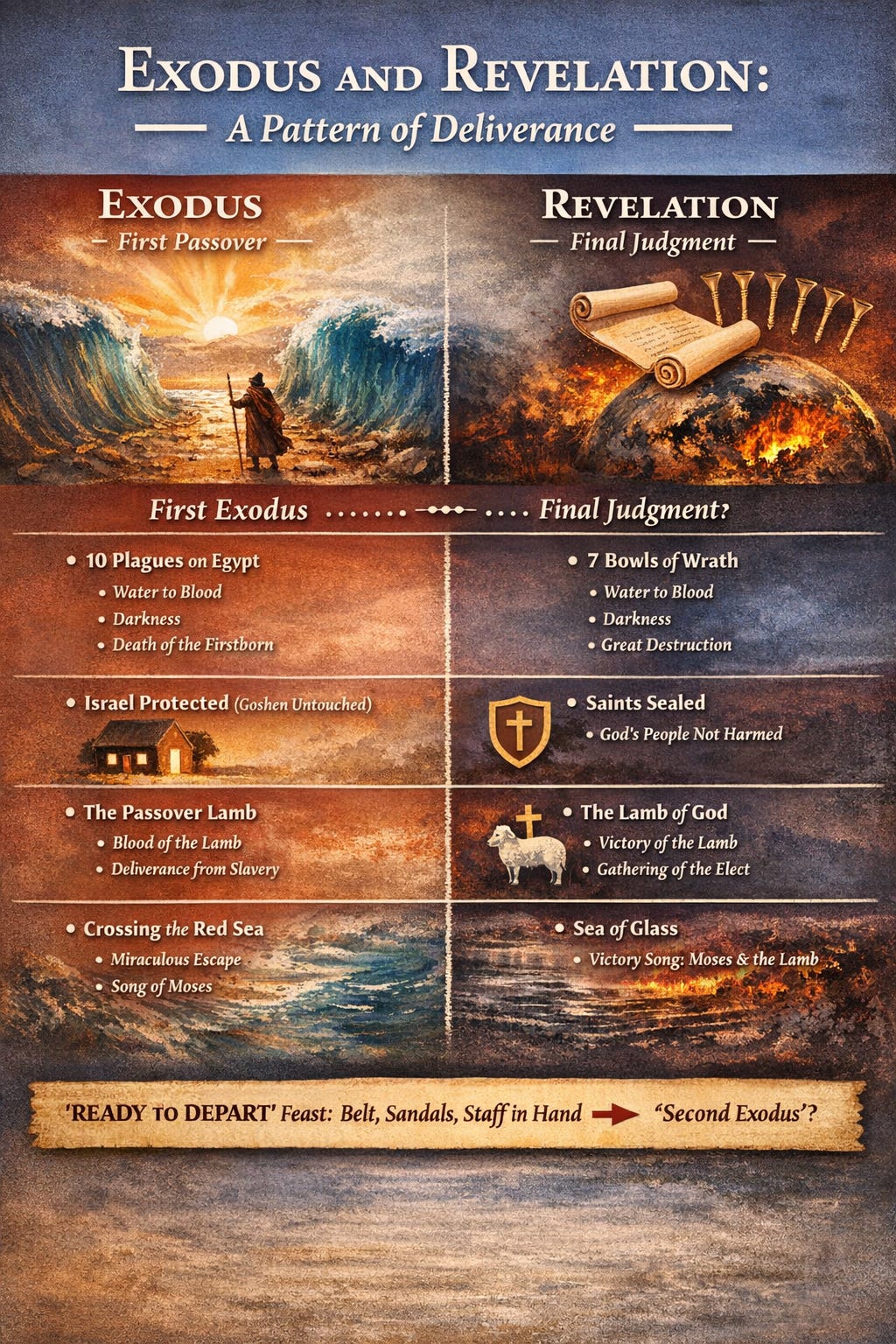
This argument is built on pattern recognition: when you lay Exodus next to Revelation, the overlap starts to feel less like coincidence and more like “design.” They emphasize that Passover is the one appointed time (moed) that looks like a departure drill – “belt on, sandals on, staff in hand” – a feast encoded with movement, urgency, and rescue.
The brothers’ most attention-grabbing “spark” comes from a Masoretic vs Septuagint (LXX) comparison in Jeremiah: in the Masoretic tradition (reflected in NKJV), the end-time regathering is described as gathering from “the ends of the earth.” But in some LXX witnesses, that same gathering phrase appears with an added locator: “at the feast of Passover.”
They’re careful to say they want “two witnesses” before being dogmatic, and they note that Jeremiah’s chapter numbering doesn’t always line up between MT and LXX (MT Jer 31 often aligns with LXX Jer 38 in some systems).
My Video | Anchored To Truth – Video | Transcript | Is Jesus Returning at Passover? Calendar Confusion & End Times Discussion
1) Core thesis of the episode
They’re proposing a big Exodus → Revelation pattern, where Passover is not only a memorial of the first Exodus, but also a likely template for the end-time deliverance / regathering (what they call a “second Exodus”). Their hook is:
- Passover is the only mo’ed (appointed time) that’s explicitly “travel-ready”—belt on, sandals on, staff in hand (Ex 12:11 NKJV). (Bible Gateway)
- Revelation’s judgments resemble Exodus plagues; God again distinguishes/protects His people while striking the rebellious.
- They connect this to a controversial-seeming LXX wording in Jeremiah that appears to place the regathering “at the feast of Passover.” (Laparola)
2) The “smoking gun” claim: Jeremiah MT vs LXX
They say their study group noticed that in Masoretic-based translations (like NKJV), Jeremiah describes a regathering “from the ends of the earth,” but the LXX includes “to the feast of Passover.”
NKJV (Masoretic tradition) — Jeremiah 31:8
“…gather them from the ends of the earth…” (Bible Gateway)
LXX (Brenton / LXX English) — Jeremias 38:8 (often aligned to MT Jer 31:8)
“…gather them from the end of the earth to the feast of the passover…” (Laparola)
Important nuance: the episode also notes chapter numbering differences (Jeremiah 31 in MT aligning with Jeremiah 38 in some LXX traditions). (For a reference table of ordering differences, see (Christian Classics Ethereal Library).)
3) Their Exodus ↔ Revelation parallels (highlights)
A) Plagues + “distinction” between God’s people and the world
They emphasize that in Exodus, YHWH judged Egypt while shielding Israel, and they read Revelation similarly—judgment targeted, not random, with a “marking/distinction” motif.
B) “Travel-ready” Passover as an end-time “departure template”
They emphasize the Passover dress-code: belt, sandals, staff, haste (a readiness posture), then ask: Why is Passover uniquely framed that way unless it foreshadows another deliverance? (They then link that to the elect being gathered out.) (Bible Gateway)
C) “Song of Moses” appears in Revelation
They see a “structural rhyme”:
- Exodus 15: Israel sings the Song of Moses after deliverance through the sea
- Revelation 15: saints sing “the song of Moses… and the song of the Lamb” (Bible Gateway)They call out how striking it is that Revelation’s victory song is explicitly “Moses + Lamb,” matching Passover’s storyline.
4) Their “calendar delta” angle (Last Supper / Passion timing)
A major supporting thread is the Passover-timing tension in the Gospels, especially:
- Jesus “kept the Passover” with His disciples (they quote Matt 26 language as explicit).
- Yet John 18:28 says the Judean leaders avoided defilement so they could still “eat the Passover.” (Bible Gateway)They interpret that as evidence of calendar disagreement in the Second Temple period, not a modern-only debate.
They also mention a “three days” echo: Jesus missing for three days as a child during Passover travel (Luke 2), which they treat as a narrative parallel to later “hidden then found” themes.
5) Jubilees / apocrypha as supporting context
They treat Jubilees as “contextual witness” (not equal to canon), especially on:
- unclean spirits / Mastema aiding deception (they connect that to Exodus magicians and to end-times deception patterns). (and broader context across the transcript)
They also explicitly state their method: they want “two witnesses” and may consult DSS, LXX, MT, etc., rather than staking everything on a single textual line.
6) “So why would Passover be a plausible return window?”
Their reasoning (as presented) is basically:
- Exodus is the prototype deliverance
- Revelation replays the prototype pattern (plagues + distinction + liberation)
- Passover uniquely encodes departure-readiness (staff/shoes/haste)
- Jeremiah LXX line appears to attach regathering language to Passover explicitly
- Revelation 15 explicitly joins Moses + Lamb in the victory song
They also acknowledge dissent inside Torah-observant communities: some expect Trumpets/Tabernacles emphases, and they present this as a “strong parallel worth testing,” not a final dogma.
7) Some “Helpful Guardrails”
- To make it clear what is textually explicit vs inferred:
- Explicit: Revelation 15 includes Song of Moses + Lamb (Bible Gateway)
- Explicit: LXX Jer 38:8 contains “to the feast of Passover” (Laparola)
- Inferential: “therefore Messiah returns on Passover”.. could be!
- Note the textual history issue: Jeremiah’s LXX differs in ordering and sometimes wording from MT; don’t oversell one phrase without acknowledging that reality. (Christian Classics Ethereal Library)
- Let’s keep the pastoral posture these brothers have modeled: unity despite calendar differences.
On the Iran Situation:
What’s happening (brief, factual framing)
Recent reporting describes a major escalation involving U.S. strikes on Iranian targets and Israeli strikes on Iranian energy / petrochemical infrastructure, with the Strait of Hormuz and regional energy flows becoming part of the conflict pressure points. (Reuters) There’s also been public rhetoric invoking God as backing for the campaign, which is spiritually dangerous territory. (The Washington Post)
A Torah-and-Prophets lens: why we should not call this “ordained by Yah”
Scripture gives us clear criteria for judging the spirit behind a cause. When leaders claim divine sanction for violence, the Bible consistently warns: don’t confuse power with righteousness.
1) Yahweh hates innocent blood and “policy violence”
- Proverbs 6:16–19 (NKJV) lists what Yahweh hates, including “hands that shed innocent blood.”
- Isaiah 10:1–2 (NKJV) condemns decrees that crush people: “Woe to those who decree unrighteous decrees… to rob the needy.”
- Habakkuk 2:12 (NKJV): “Woe to him who builds a town with bloodshed.”
You don’t need special revelation to say: when civilian lives are crushed, when infrastructure and livelihoods are targeted, when the proud boast in destruction, you are not watching “holy war”—you’re watching the kind of thing the prophets pronounce woe over.
2) The prophets rebuke religious language used to justify violence
A major biblical pattern: leaders love to say “God is with us,” while the prophets say, “No—your hands are full of blood.”
- Isaiah 1:15–17 (NKJV): “When you spread out your hands… I will hide My eyes… Your hands are full of blood… Seek justice.”
- Amos 5:21–24 (NKJV): God rejects worship songs when justice is absent.
So when political leaders frame war as righteous because they invoke God—Scripture says: that’s precisely when you should tremble and test the spirits (1 John 4:1).
3) Yahweh is not a tribal mascot: “Are You for us?” → “No.”
Joshua 5 is the corrective you just exegeted:
- Joshua asks: “Are you for us or our adversaries?”
- The Commander answers: “No… as Commander of YHWH’s army I have now come.”
That “No” destroys modern nationalist theology. The question isn’t “Is God on our side?” The question is “Are we aligned with His righteousness?” (justice, mercy, truth, humility—Micah 6:8).
4) Messiah’s ethic forbids our hearts from celebrating destruction
Even when judgment is real, Messiah trains His people away from hate-driven triumphalism:
- Matthew 5:9 (NKJV): “Blessed are the peacemakers…”
- Matthew 5:44 (NKJV): “Love your enemies…”
- Romans 12:19–21 (NKJV): “Vengeance is Mine… overcome evil with good.”
That doesn’t mean governments can’t wield force (Romans 13), but it does mean disciples must not call war “ordained” as if it were automatically righteous – especially when mixed with propaganda, pride, and the predictable crushing of civilians.
How this might relate to the Second Coming (without date-setting)
The Scriptures don’t give us permission to assign every war to a specific prophecy – but they do tell us what an age of escalation looks like (i.e., we know the season and are called to watch for the signs):
1) Messiah warned: “wars and rumors of wars… but the end is not yet”
- Matthew 24:6–8 (NKJV): conflict is part of the birth-pains pattern—real, intense, but not a license to set dates.
2) The nations rage; Yahweh remains sovereign
- Psalm 2 (NKJV): the nations rage, rulers plot – but Heaven isn’t panicking. This is a stabilizer for your audience: don’t be hypnotized by headlines.
3) Revelation’s “Exodus echoes” should sober us, not excite us
Given the Passover/Exodus pattern you’ve been studying, the warning is: when people start talking like Pharaoh – hardening, escalating, justifying destruction, you are watching the kind of moral atmosphere Scripture associates with judgment cycles, not necessarily “the final week” on a chart.
I’m not claiming a date. I am saying the spiritual temperature feels like the patterns Scripture warns about: pride, propaganda, violence, and hardened hearts.
What we’re watching in the Middle East is not something that is ordained by the Most High Yah. Torah and the Prophets are consistent: Yahweh hates innocent blood being shed, hates crooked decrees, and rebukes leaders who use His Name to varnish violence.
Yet Messiah teaches His disciples to be peacemakers, to refuse vengeance in the heart, and to fear God rather than follow the rage of nations. We are also called to pray for our leaders, and remember that God places people into these positions ultimately to His glory and so that His will can be carried out.
Yes, governments will wage wars, and Scripture says wars will increase as the age groans. But “wars and rumors of wars” are not proof of righteousness, and they’re not a permission slip to call destruction holy. If anything, this hour calls for repentance, truth-telling, and prayer, because when men boast in bombing and speak as though God endorses it, the Bible’s alarm bells start ringing.
What The Remnant Must Do:
- Refuse bloodlust (Prov 24:17; Matt 5).
- Pray for all men, including leaders (1 Tim 2:1–2) without endorsing their violence.
- Watch and stay faithful (Matt 24:42; Rev 14:12) – Torah written on the heart, testimony of Messiah intact.
For more info on Radio Remnant Ministries (RRM):
Website: https://www.remnant-radio.com
Substack: https://saul2paul.substack.com/
Tiktok: / paulcurto4