
Why Torah Can’t Give Life, But It Still Guides the Living
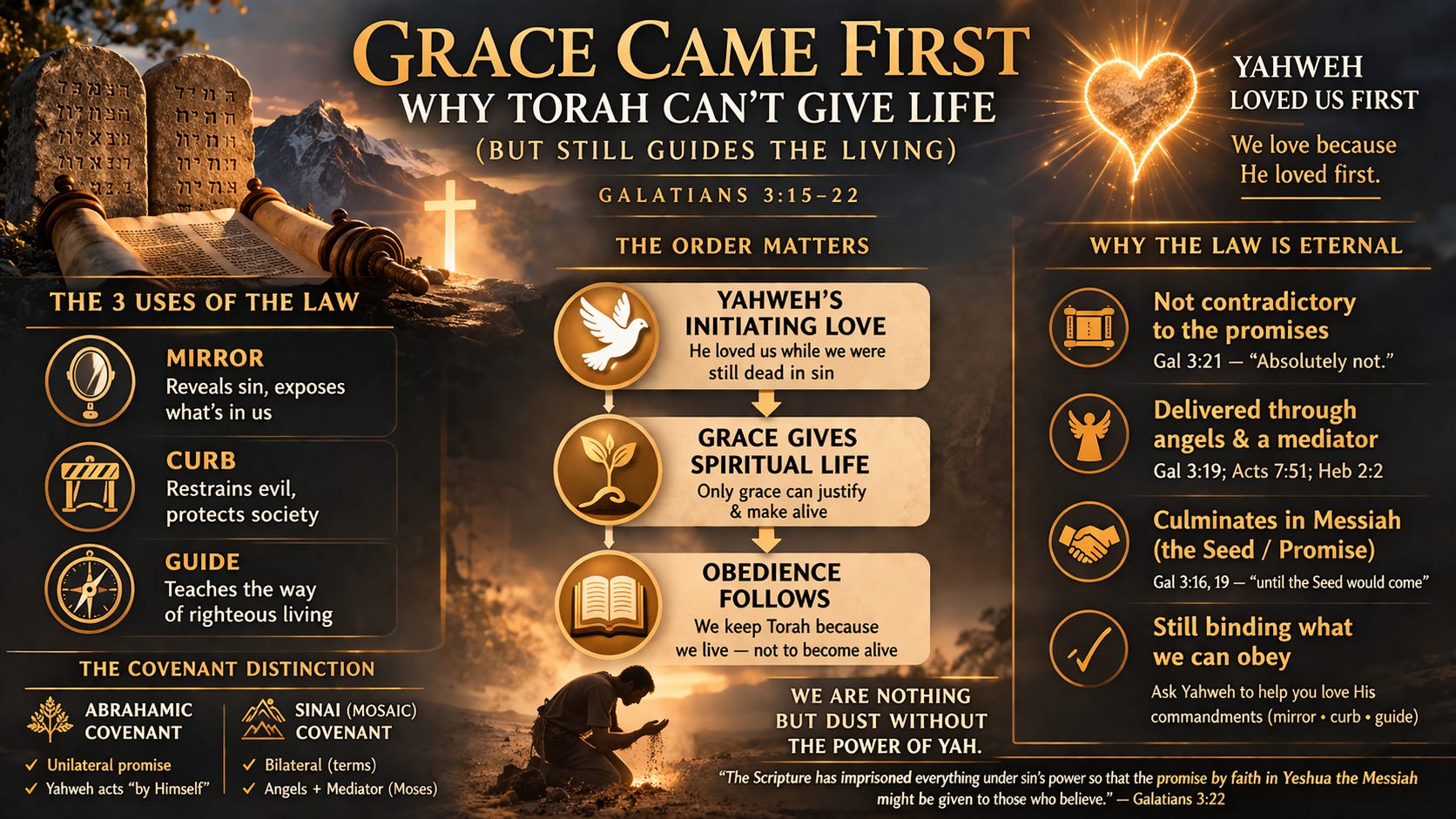
Grace came first, because we were dead first
Galatians 3 is one of the most misunderstood battlegrounds in modern Christianity, especially in “law vs. grace” debates. The tragedy is that people often treat Torah like it’s either a savior or a villain, but Paul does neither of these.
In this sermon I link to below called “Galatians Pt. 33”, Brother Matthew Janzen leans into the point exactly where most confusion on this topic stems: the Law was never designed to give you life. If a law could give life, Paul says, “righteousness would certainly be by the law.” But it can’t do something it was never intended to do in the first place.
That’s not an insult to Torah, but rather it’s a proper tool assignment. Torah is not a defibrillator. Torah is not the Creator. Torah is not Moses’s instruction and not one word was written by Moses.
Torah is Yahweh’s instruction, holy and good, it is perfect (Psalm 19:7), and we shoulr meditate on it day and night (Joshua 1:8), but it cannot resurrect a dead person. Only Yah can do that by grace.
Brother Matthew puts it bluntly: “The law will never justify you or save you… only grace can do that.”
And here’s the order that destroys works-based boasting: you cannot keep Torah before Yahweh gives you life. Obedience comes after our awakening which is only made possible by His grace.
We must remember, we are nothing but dust – dirt in fact (stone) – without the power of Yah. Thus “in order for you to even be obedient to the law, you have to be given spiritual life first.”
The Law is not useless. But we must view what it is intended to do, and what it’s not intended to do. It’s not a life-giver.
Paul’s question in Galatians 3 is honest: “Why then the Law?” (3:19).
And Brother Matthew’s answer refutes modern day lazy assumptions that the Law is obsolete, fading away, or done away with (we have reviewed why that is bad teaching in prior articles and videos in this series).
The Law has at least three foundational uses:
- It Serves As A Mirror: it exposes what’s in us so we can see clearly the smudge on our face.
- It Serves To Curb Dangerous Behaviors: it restrains evil by creating safe boundaries around what is helpful and what is unhelpful and possibly even dangerous to us.
- It Serves As Our Guide: it teaches the way of right living, the ancient path of neither turning to the left or to the right; it’s Yah’s righteous ways.
He uses a simple illustration: you don’t use a hammer to change a lightbulb, or a screwdriver to clip your nails! Those are the wrong tools for the job, obviously. But that doesn’t mean that a hammer is worthless, or screwdriver, or nail clipper.
The same principle applies for the Torah: it isn’t the instrument of justification, but it absolutely remains vital for what Yah designed it to do: help us see what sin is, help us to stay away from sin, and help us follow him.
“Until the Seed”: Torah culminates in Messiah, but never disappears
A major pivot point in Galatians 3 occurs with Paul’s phrase: “It was added because of transgressions, till the Seed should come to whom the promise was made; and it was appointed through angels by the hand of a mediator.” (3:19). Brother Matthew points out that “until” signals movement toward a goal, not a scorched-earth cancellation of Torah’s value.
Messiah embodies what Torah teaches and requires, and only He does what Torah cannot do: justify and give life.
This is where Torah-observant discipleship stays honest in the dispersion (that’s the time that we are in during the present age). Some temple-dependent aspects of torah are currently out of sync with today’s reality – there’s no temple here on earth, no Levitical priesthood, and we can’t carry out the feasts to the fullness of the instructions for example – but any commandment you can obey is not something to shelve with excuses that the law is too hard and we don’t have to keep any of it anymore.
Brother Matthew is clear: if you read a command you can obey, don’t set it aside; rather ask Yahweh to help you become a lover of that commandment.
That’s not salvation-by-law or works based salvation, that’s life-after-grace. We follow and keep the law because we love his law and love what he has done for us!
Angels, Moses, and why Paul is actually honoring Torah
Paul says the Law was “ordered through angels by means of a mediator” (Gal 3:19). Most Christians read that and assume it’s a downgrade.
Brother Matthew argues the opposite: Paul is upplaying (storing up) Torah’s holiness. One big insight is he ties the “angels” language to Stephen’s rebuke (i.e. – “you received the law under the direction of angels”), and Hebrews’ warning that the message spoken through angels was legally binding.
Then he cross-references Deuteronomy 33:2, where Yahweh comes with “holy ones,” and notes the Septuagint’s “angels” reading as support. “The Lord came from Sinai, And dawned on them from Seir; He shone forth from Mount Paran, And He came with ten thousands of saints; From His right hand Came a fiery law for them.” (NKJV)
His point: Torah didn’t fall out of the sky as a human invention. It came from the Holy One through His holy messengers, and was mediated through Moses – who stood as the go-between in the covenant between Yah and man.
So no: the Law is not “contrary to the promises.” In fact, Paul says “Absolutely not.” Therefore torah and promise are not enemies of each other, they just have different roles.
The Abrahamic promise is unilateral; the Sinai covenant is bilateral.
Galatians 3 also makes a covenant-structure distinction: Yah’s promise to Abraham is portrayed as Yah acting “by Himself” (the unilateral promise pattern), while Sinai involved angels, a mediator, and covenant terms (a bilateral promise).
Brother Matthew emphasizes that Paul’s “mediator” language underscores this difference. Why does that matter? Because it nails the pride issue:
If salvation is grounded in the unilateral promise fulfilled in Messiah, then your flesh can’t boast.
You didn’t negotiate yourself into life, and nothing of your works can ever save you. Remember: you are dust, yet Yah did something to you before you ever did something for Him – he knew you before the world began. He envisioned you, He made you, He loved you, and He claimed you as His before you even existed!
Grace came first (and it had to)
This is where the sermon lands with a holy hammer: grace precedes works, even those works that proceed from faith.
Brother Matthew says it plainly: “Which came first, grace or works? … grace came first.” And, “You love because He loved first.”
Then Galatians 3:22 seals it: Scripture has “imprisoned everything under sin” so that the promise would be given by faith in Yeshua our Messiah.
That means every human being – religious or rebellious – starts in the same cell: sin’s dominion. And a prisoner can’t unlock his own door. This is why grace isn’t a “nice add-on.” Grace is the only rescue possible.
So what is Torah for, if it can’t save us?
Torah is not Jacob’s ladder into heaven. It is the path of the redeemed on earth.
Keeping the commandments is how we love the Lord our God with all our heart, mind, soul, and strength, and it is how we love our neighbor like our self. Furthermore,
- It exposes sin (acts as a mirror)
- It restrains evil (acts as a curb)
- And it teaches Yah’s ways (acts as a guide)
Once Yah gives us life through His grace, His Torah becomes what it always was meant to be for His people: instruction for a holy walk while here on His earth.
But the order is what matters:
Grace → life → obedience; Not: obedience → life
Or said even more simply:
We keep the commandments because we live; we don’t keep commandments to become alive.
Closing exhortation
If you’re hearing “grace” and feeling nervous, good! That’s your pride dying. Because you cannot have too much grace – you and I need all the grace Yah will freely give.
But if you’re hearing “Torah” and looking for excuses, you need to repent! Yah isn’t looking for people who practice loophole religion, or those who are knowingly disobedient, or even lawless; He’s looking for people who love His commandments and do them.
But never invert the order: We are only dirt without the breath of Yah. And when He breathes life into us, when He loves us first, then and only then can we truly walk in His ways.
Finally, in the new covenant to come he will write his law (his ways) on our hearts and in our minds so that we will never sin again (Ezekiel 36:24-28; Jeremiah 31:31-34).
Only then will we be perfected (1 Corinthians 15:50-55).
And we know that all creation groans for that great day when the saints will be revealed (Romans 8:18-23)! Amen & hallelujah!!
Sermon Summary Details
Video | Transcript | Galatians, pt. 33 (The Law is Not a Life-Giver, 3:20-22)
A. Text framing and flow (Gal 3:15–22)
- Paul argues from covenant logic: a ratified covenant isn’t set aside or amended (v.15).
- The promise was to Abraham and his singular “Seed” (Messiah) (vv.16–18).
- The Law came 430 years later and does not cancel the promise (v.17).
- “Why then the Law?” → “added because of transgressions… until the Seed would come” (v.19).
B. The three foundational “uses” of the Law
Brother Matthew’s core teaching tool:
- Mirror (shows sin / reveals what’s in us)
- Curb (restrains evil in society)
- Guide (teaches the righteous path)He stresses: the law was not given to justify or give life, but that doesn’t make it useless (hammer/chisel illustration).
C. “Until” in Gal 3:19 — goal/culmination, not total cancellation
- “Until” denotes movement toward a goal—the law points toward Messiah and finds culmination in Him.
- He affirms some parts ceased in practice after 70 AD (temple-related), but insists anything you can obey still stands as “moral law / way of life.”
- Key pastoral admonition: if you can obey a commandment you read, don’t shelve it—ask Yahweh to make you love it.
D. Angels + mediator: Paul “upplays” the Law, not downplays it (Gal 3:19–20)
- Paul says the law was “ordered through angels by means of a mediator” (v.19).
- He ties this to Acts 7 (Stephen: law received “by angels”) and Hebrews 2 (“message spoken through angels” legally binding).
- He argues this angelic delivery increases the law’s validity/holiness.
- He cross-references Deut 33:2 and notes the LXX reading (“angels” language) as support.
- Mediator = Moses: the go-between in a bilateral covenant (Sinai).
E. Covenant contrast: Abrahamic promise (unilateral) vs Mosaic covenant (bilateral)
- Abrahamic covenant: Yahweh made promises “by Himself” (no mediator, no conditions in that sense; Abraham trusts).
- Mosaic covenant: angels + mediator + conditions (bilateral structure).
- Gal 3:20 (“mediator not for one… but Yahweh is one”) is used to highlight this covenant-structure difference.
F. The headline: the Law is not contrary to the promises, but it is not a life-giver (Gal 3:21)
- “Is the Law contrary to the promises?” → “Absolutely not.”
- If a law could give life, righteousness would be by law—but it cannot (v.21).
G. Grace precedes obedience: Yah loved first; life precedes law-keeping
- Spiritual life is given by grace, not by law.
- “The law will never justify you or save you… only grace.”
- “In order for you to even be obedient… you have to be given spiritual life first.”
- “You love because He loved first… grace came first.”
H. Gal 3:22 — everything imprisoned under sin so the promise is by faith
- No one is exempt; all are “imprisoned under sin” so the promise comes by faith in Messiah.
- Boasting is annihilated; grace is exalted.
For more info on Radio Remnant Ministries (RRM):
Website: https://www.remnant-radio.com
Tiktok: / paulcurto4
Twitter: https://x.com/service2disrupt
Brighteon: https://www.brighteon.com/channels/saul2paul/home