
The Son Was Promised, Part 1
Before Bethlehem: What Were Israel and the Ancient Scriptures Waiting For?
See my YouTube videos for a walkthrough of this series:
The Son Was Promised Part 1, Episode 25
The Son Was Promised Part 2, Episode 26
The Son Was Promised Part 3, Episode 27
I’ve been having conversations lately with non-Christians who believe that Jesus lived, was a righteous man, may have been a prophet, but that they don’t believe he was or is the son of God and they reject him as our Messiah.
Because of those conversations, I’ve felt inspired to make this next set of videos which I will try and cover in two main parts. My primary question is: given that there is so much prophecy of our Messaiah’s coming (the first time), that has already been fulfilled.. how can one who studies and believes the scriptures reject that he already came?
The secondary questions is, if he came and you reject him, then how are you in right standing with the one who sent him.
The third question is, if he already has come and the remaining prophecies are that he will be coming back again (possibly soon and also quickly), what can and should we do to prepare for that event?
But first things first:
What if we approached Yeshua without beginning in the book of Matthew?
What if, before asking what Christians say about Jesus of Nazareth, we went backward?
Back before Bethlehem.
Back before Rome occupied Judea.
Back before Herod.
Back before the New Testament.
Back into Torah, the Prophets, the Psalms, the book of Daniel, as well as some of the sacred writings circulating among many ancient Jewish communities before and around the first century.
What kind of person were these Scriptures teaching Israel to expect?
That question matters whether you identify as Christian, Jewish, Muslim, atheist, or none of the above.
Muslims recognize Yeshua, or Isa, as Messiah and prophet but deny that he is the Son in the sense proclaimed by the New Testament. Rabbinic Judaism rejects the Christian identification of Yeshua as Messiah. Many secular readers accept that Jesus existed while regarding the theological claims about him as later Christian development.
So rather than beginning with those later disagreements, let us begin with something earlier.
What did the ancient Scriptures actually say was coming?
The argument of this two-part series on the Messiah is not that every ancient passage is equally descriptive or explicit. Nor should we pretend that every Jewish reader has interpreted these passages as Christians do.
Instead, I want to demonstrate something cumulative.
Across multiple books, centuries, authors, literary genres, and Jewish traditions, an extraordinary portrait develops:
- A promised Seed.
- A ruler from Judah.
- A prophet like Moses.
- A Son associated with Yahweh’s throne.
- A Davidic King.
- A rejected righteous one.
- A suffering Servant.
- A pierced figure.
- A priest who somehow stands outside the normal Levitical succession.
- A heavenly Son of Man.
- A judge of kings and nations.
- A Messiah whose kingdom ultimately fills the whole earth.
Then Yeshua appears.. for a second time.
That is where Part 2 will begin.
But first we have to understand the leading up to that event.
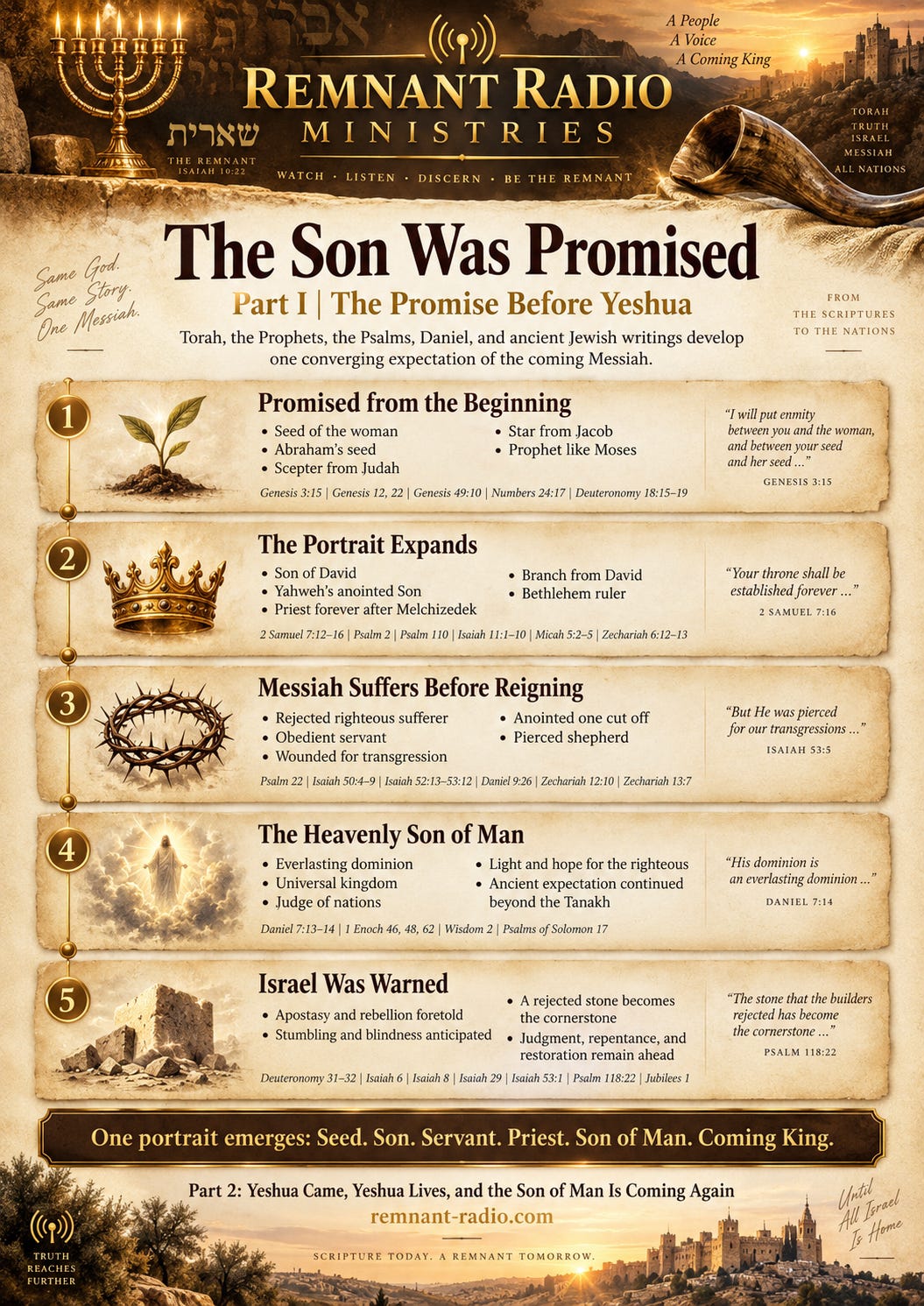
1. The story begins with a Seed
The first messianic trajectory begins almost as soon as mankind falls.
Genesis 3:15
After the serpent’s deception, Yahweh declares hostility between the serpent and the woman, between his seed and hers. The woman’s seed will ultimately crush the serpent’s head while himself being wounded.
Read the full passage in Genesis 3:14-15 NKJV.
At this stage Scripture has not yet told us who this descendant will be.
Only this:
someone coming through humanity will ultimately defeat the enemy responsible for mankind’s rebellion.
That promise begins narrowing almost immediately.
2. The Seed comes through Abraham
Read:
Genesis 12:1-3
Genesis 17:4-8
Genesis 22:15-18
Genesis 26:3-5
Yahweh promises Abraham descendants, land, covenant, and something much larger.
Through Abraham’s seed, all nations of the earth will be blessed.
The biblical story is therefore never merely about rescuing one ethnic group.
Yahweh chooses Abraham and Israel as the vessel through whom blessing ultimately reaches the nations.
The promised deliverer is going to emerge from this covenant family.
But Scripture keeps narrowing the line.
3. The ruler comes through Judah
Jacob’s words over Judah contain another remarkable piece of the puzzle.
Genesis 49:8-10
Read the passage carefully.
The imagery includes:
- kingship
- the scepter
- rulership
- Judah
- and ultimately the obedience or gathering of peoples
Whatever interpretive questions remain around the precise Hebrew wording of verse 10, the passage establishes Judah as the royal tribe.
Later Scripture narrows the promise further.
Not merely Abraham.
Not merely Israel.
Not merely Judah.
David.
4. Balaam sees a Star and Scepter coming from Jacob
One of Torah’s most remarkable royal prophecies comes from an unlikely source.
Balaam looks toward Israel and declares:
Numbers 24:15-19
Read the full oracle in the NKJV.
Its most famous line announces:
“A Star shall come out of Jacob; A Scepter shall rise out of Israel.”
The passage portrays a future ruler overcoming Israel’s enemies.
Centuries later, the Testament of Judah would use remarkably similar Star imagery when describing a future righteous figure arising from Judah.
We will return to that.
For now, the Torah itself has established another expectation:
a royal conqueror is coming from Jacob.
5. Moses says another prophet is coming, and Israel must listen to him
Near the end of his life, Moses announces something crucial.
Deuteronomy 18:15-19
Yahweh will raise up:
“a Prophet like me”
from among Israel.
The warning attached to this promise is serious.
Israel is commanded to hear him.
Yahweh says that whoever refuses to hear the words spoken in His name will be held accountable.
This creates a fascinating expectation.
Israel is not merely waiting for another king.
They are waiting for another Moses-like prophet.
Someone authorized by Yahweh.
Someone whose words Israel is commanded to hear.
The New Testament will later explicitly identify Yeshua with this prophecy in Acts 3:18-26.
But even before we get there, Torah has established the category.
6. Then Yahweh makes an everlasting covenant with David
The royal line becomes much more specific in 2 Samuel 7.
Read:
2 Samuel 7:8-16
1 Chronicles 17:11-14
Yahweh promises David a descendant whose throne and kingdom will have an enduring, ultimately everlasting dimension.
This becomes the foundation of biblical Messianic hope.
Later prophets repeatedly return to it.
Jeremiah 23:5-6
A righteous Branch arises for David.
He reigns as King.
He executes judgment and righteousness.
Judah is saved.
Jeremiah 33:14-17
Again Yahweh promises the righteous Branch of David.
Isaiah 11:1-10
A shoot comes from Jesse.
The Spirit of Yahweh rests upon him.
He judges in righteousness.
His reign transforms the world.
And the Gentiles seek him.
Now another line has appeared:
the coming Davidic ruler does not merely restore Israel. His reign reaches the nations.
7. Psalm 2 introduces Yahweh’s Anointed and His Son
Now we reach one of the most important passages in the entire discussion.
Read Psalm 2:1-12 NKJV in full.
The nations rage.
Their rulers gather against:
Yahweh and His Anointed.
Yahweh nevertheless installs His King upon Zion.
Then comes the startling declaration of verse 7:
“You are My Son, Today I have begotten You.”
The Son receives the nations as his inheritance and the ends of the earth as his possession.
The psalm ends by warning earthly rulers to submit to him.
Whatever conclusions someone reaches about the metaphysics of divine sonship, the text itself cannot simply be erased.
Ancient Israel possessed a psalm in which:
- Yahweh has an Anointed One
- Yahweh identifies him as Son
- the Son receives the nations
- kings are commanded to submit to him
- refuge is associated with him
That becomes enormously important when we later hear the voice from heaven at Yeshua’s baptism and transfiguration.
8. David sees his Lord seated beside Yahweh
Psalm 110 takes the mystery even further.
Read Psalm 110:1-7.
David writes:
“The LORD said to my Lord, ‘Sit at My right hand…’”
Yeshua himself later asks his opponents about this passage.
If Messiah is merely David’s descendant, why does David call him “Lord”?
But Psalm 110 contains another surprise.
The enthroned figure is not merely king.
He is also told:
“You are a priest forever According to the order of Melchizedek.”
Now the categories become very unusual.
Israel already has a priesthood.
The descendants of Aaron serve as priests under Torah.
Yet Psalm 110 anticipates a figure who is:
David’s Lord + enthroned at Yahweh’s right hand + ruler over enemies + priest forever after the order of Melchizedek.
This is foundational to understanding Hebrews.
The coming Messiah is not only King.
He is also Priest.
9. Zechariah brings kingship and priesthood together
Read:
Zechariah 3:8
Zechariah 6:9-13
Zechariah speaks of the coming Branch.
In Zechariah 6, the Branch builds Yahweh’s temple and carries royal honor.
The passage intriguingly places priestly and royal imagery together.
This is important because normal Israelite kings were from Judah while the Aaronic priesthood came through Levi.
Yet Scripture continues moving toward a figure in whom royal and priestly functions converge.
Psalm 110 has already prepared us for the explanation:
Melchizedek.
10. But something strange happens to the expected King
Up to this point we might expect a simple story.
Messiah appears.
Messiah conquers.
Messiah reigns.
But the Prophets and Psalms introduce something far more surprising.
Before the glory comes suffering.
Before universal recognition comes rejection.
Before exaltation comes humiliation.
11. Psalm 22 and the suffering righteous one
Read Psalm 22:1-31 slowly.
The psalm begins with the terrible cry:
“My God, My God, why have You forsaken Me?”
The righteous sufferer is mocked.
His enemies ridicule his trust in Yahweh.
His physical suffering is vividly described.
His garments become objects of division.
Yet Psalm 22 does not end in defeat.
The sufferer is vindicated.
And the vision expands until:
all the ends of the world remember and turn to Yahweh, and the families of the nations worship.
That pattern matters.
Suffering first. Vindication afterward. Worldwide worship eventually.
When we reach the crucifixion narratives, the parallels become impossible to ignore.
See:
Matthew 27:35-46
Mark 15:24-34
John 19:23-24
12. Isaiah’s Servant suffers before he is exalted
Isaiah develops this pattern with extraordinary clarity.
Isaiah 42
The Servant brings justice to the nations.
Isaiah 49
The Servant restores Jacob, yet his mission is too great to stop there.
He becomes a light to the Gentiles so Yahweh’s salvation reaches the ends of the earth.
Isaiah 50:4-9
The obedient Servant suffers shame and physical abuse yet trusts Yahweh for vindication.
Then comes Isaiah 52 and 53.
Read the complete unit:
Isaiah 52:13 through Isaiah 53:12.
Do not begin at 53:1. The poem starts at 52:13:
“Behold, My Servant shall deal prudently; He shall be exalted and extolled and be very high.”
And then everything seems to reverse.
The exalted Servant is disfigured.
Despised.
Rejected.
Acquainted with grief.
The text says he bears the griefs and sorrows of others.
He is wounded in connection with transgression.
He suffers silently.
He is cut off from the land of the living.
He receives a grave despite having committed no violence or deceit.
Yet after death the poem speaks of him seeing the results of his suffering and being exalted.
Here we should acknowledge the Jewish interpretive objection fairly.
A prominent Jewish interpretation identifies the Servant collectively with Israel, especially because Isaiah elsewhere calls Israel Yahweh’s servant.
That observation deserves to be heard.
But it does not make the Messianic reading disappear.
Isaiah’s Servant sometimes appears distinguished from sinful Israel, particularly when the Servant’s work includes bringing Jacob back to Yahweh in Isaiah 49.
Whatever conclusion one reaches, Isaiah has unquestionably established the theological pattern:
an innocent righteous Servant suffers, bears others’ wrongdoing, dies, and is subsequently vindicated and exalted.
That pattern becomes central to the New Testament’s understanding of Yeshua.
13. Wisdom of Solomon gives us another astonishing rejected “Son”
Now step outside the Protestant 66-book collection and into a book retained as Scripture within Catholic and Orthodox traditions.
Wisdom of Solomon 2:12-24 describes wicked men conspiring against a righteous man.
The public-domain KJV Apocrypha describes their reasoning:
“He professeth to have the knowledge of God: and he calleth himself the child of the Lord.”
They resolve to test what happens at his death.
They reason that if the righteous man really is the Son of God, God will help him.
Then compare Matthew 27:39-43.
At Yeshua’s crucifixion, his mockers use essentially the same logic:
He trusted God.
He claimed divine sonship.
Let God rescue him.
Wisdom 2 does not name Yeshua.
We should not pretend it does.
Its original subject is the archetypal persecuted righteous person.
But that is precisely why the parallel matters.
Jewish wisdom tradition already possessed the conceptual framework of:
a righteous Son of God, hated because of his righteousness, subjected to a shameful death while enemies mock his relationship with the Father.
Yeshua’s passion fits the pattern with remarkable precision.
14. Daniel predicts an Anointed One being “cut off”
Read Daniel 9:24-27.
The chronology of Daniel 9 has produced substantial disagreement among Jewish and Christian interpreters.
But one point should not get lost inside the chronology debates.
Daniel describes an anointed one, a Messiah, who is subsequently cut off.
Afterward the text describes devastating events affecting Jerusalem and the sanctuary.
The significance for our argument is straightforward.
The Hebrew Scriptures themselves do not require that the arrival of an anointed figure result immediately in unbroken earthly triumph.
An anointed one can appear.
And be cut off.
That makes the concept of a suffering Messiah much harder to dismiss as a Christian invention after the crucifixion.
15. Zechariah’s King arrives humble
Another extraordinary sequence appears in Zechariah.
Zechariah 9:9-10
First the king comes to Jerusalem:
- righteous
- bringing salvation
- humble
- riding on a donkey
Then his dominion eventually extends throughout the earth.
Notice the tension.
The same prophecy contains:
humble arrival + worldwide reign.
The Gospels explicitly apply the donkey imagery to Yeshua’s entry into Jerusalem:
Matthew 21:1-11
John 12:12-16
But Zechariah has still more to say.
16. The rejected shepherd and pierced one
Read:
Zechariah 11:4-14
Zechariah 12:10 through 13:1
Zechariah 13:7-9
Zechariah includes several striking motifs later associated with Yeshua:
- rejection of Yahweh’s shepherd
- thirty pieces of silver
- the money being associated with the house of Yahweh and the potter
- a pierced figure
- national mourning
- a fountain opened for sin and uncleanness
- the shepherd being struck
- the sheep scattering
The New Testament directly connects these motifs to Yeshua.
See:
Matthew 26:31
Matthew 27:3-10
John 19:34-37
Again, the cumulative pattern matters more than any isolated proof text.
17. Then Daniel sees someone coming with the clouds
Now we reach one of the most important passages in the entire Bible for understanding Yeshua.
Read Daniel 7:9-14.
Daniel sees the Ancient of Days seated in judgment.
Then another figure appears:
“One like the Son of Man”
He comes with the clouds of heaven.
He approaches the Ancient of Days.
And he receives:
- dominion
- glory
- a kingdom
- service from all peoples, nations, and languages
- an everlasting dominion
- a kingdom that cannot be destroyed
This imagery is remarkable.
The Son of Man is distinct from the Ancient of Days, yet participates in a heavenly scene and receives universal authority.
And notice the clouds.
Throughout the Hebrew Scriptures, cloud-riding is strongly associated with divine activity.
See:
Exodus 13:21
Psalm 68:4
Psalm 104:3
Isaiah 19:1
Yet Daniel sees this human-like heavenly figure coming with the clouds and receiving universal dominion.
Remember that.
When Yeshua repeatedly calls himself the Son of Man, Daniel 7 is sitting behind that title.
18. Then 1 Enoch develops Daniel’s Son of Man
This is where the ancient Jewish literature becomes especially fascinating.
First Enoch was not included in the later Jewish or Protestant canons, but the complete work remains canonical in the Ethiopian Orthodox tradition. Portions of 1 Enoch were found among the Dead Sea Scrolls, and Jude explicitly quotes 1 Enoch 1:9 in Jude 14-15.
The work developed across the Second Temple period. Its section commonly called the Parables or Similitudes, chapters 37 through 71, contains particularly strong Son of Man traditions. The precise date of the Parables remains debated, in part because that section is notably absent from the surviving Qumran Enoch fragments.
That caution matters.
But so does what the text actually says.
1 Enoch 46
In R. H. Charles’s public-domain translation, Enoch sees the Head of Days beside another being whose appearance is human.
He asks who this figure is.
The answer includes:
“This is the Son of Man who hath righteousness, With whom dwelleth righteousness…”
The Lord of Spirits has chosen him.
This Son of Man brings down mighty rulers and judges unrighteousness.
Compare this with Daniel 7.
The relationship is unmistakable.
19. 1 Enoch 48 pushes the expectation even further
Read 1 Enoch 48.
The chapter says of the Son of Man that his name was named in the presence of the Lord of Spirits before the heavenly lights.
He becomes:
- a support for the righteous
- a light to the Gentiles
- the hope of the troubled
- God’s chosen one
- a figure before whom earthly rulers fall
The chapter places his identity within Yahweh’s purposes before his manifestation to the world.
That does not prove every later Christian claim by itself.
It proves something historically important.
Jewish apocalyptic thought could imagine an exalted, chosen, heavenly Son of Man long before later Christian councils debated Christology.
Christian claims about Yeshua did not arise in a conceptual vacuum.
20. The Son of Man judges the kings
Then read 1 Enoch 62.
The Son of Man is revealed in an eschatological judgment scene.
Kings and powerful rulers are terrified.
The righteous and elect are vindicated.
The Most High had preserved the Son of Man before his revelation.
When we later read Yeshua’s description in Matthew 25:31-46 of the Son of Man sitting on his throne and judging the nations, the resemblance is profound.
Whether Yeshua is drawing directly upon 1 Enoch or both are drawing upon Daniel, the conceptual world is unmistakably Jewish.
21. Second Temple Judaism also expected a Davidic Messiah
The Psalms of Solomon, probably originating in the first century BC, provide another important witness.
Psalm of Solomon 17 anticipates the Lord raising up a son of David who will:
- purge Jerusalem
- gather a holy people
- judge nations
- rule Israel
- shepherd Yahweh’s people in righteousness
Scholars routinely recognize Psalm of Solomon 17 as one of the clearest witnesses to Davidic messianism in Second Temple Judaism.
Again, this matters historically.
Messianic expectation was not retroactively invented because followers of Yeshua needed to explain him.
Jewish communities were already asking when David’s promised ruler would come.
22. The Dead Sea Scrolls preserve another remarkable expectation: Melchizedek
Among the Qumran texts is the document generally called 11QMelchizedek.
It draws together themes including:
- Jubilee release
- Isaiah 61
- judgment
- forgiveness
- atonement
- Melchizedek
- end-time deliverance
That matters because Isaiah 61 opens with the proclamation of liberty to captives.
Then, according to Luke 4:16-21, Yeshua enters a synagogue, reads Isaiah 61, and declares:
“Today this Scripture is fulfilled in your hearing.”
Later Hebrews will identify Yeshua as the eternal High Priest after the order of Melchizedek.
Suddenly several ancient streams converge:
Psalm 110 + Isaiah 61 + Melchizedek + liberation + atonement + Messiah.
23. The Testaments of the Twelve Patriarchs add another fascinating witness
Here we must proceed carefully.
The Testaments of the Twelve Patriarchs survive in forms that appears to contain Christian material. Scholars disagree regarding the precise composition history. A substantial scholarly position sees older Jewish traditions underneath later Christian interpolations, while others place greater weight on the Christian form of the existing work. Oxford scholar David deSilva describes the present form as containing distinctively Christian material while arguing for a substantial Jewish foundation. While these texts do also appear in other canons.
Therefore I would never build the case for Yeshua solely upon these texts, and I would put forth that the canonical Scriptures stand first as foundational.
But the Testaments remain fascinating historical witnesses that reinforce this theme.
Testament of Levi 18
R. H. Charles’s text says:
“Then shall the Lord raise up a new priest.”
The passage continues by describing a priest associated with righteous judgment, knowledge, light, peace, the defeat of evil, and an enduring priesthood.
That sounds striking after Psalm 110.
Testament of Judah 24
The text says:
“And after these things shall a Star arise to you from Jacob in peace…”
It then describes a man arising from Judah’s seed who walks in meekness and righteousness, receives the Spirit, and becomes associated with a righteous Branch and salvation extending outward.
The surviving form calls him:
“the Branch of God Most High”
and describes a “rod of righteousness to the Gentiles.”
Because Christian transmission may have shaped portions of this material, caution is appropriate.
But notice again which older Jewish texts stand beneath it:
Numbers 24. Isaiah 11. Davidic kingship. Spirit. Branch. Nations.
The same streams keep reappearing.
24. Jubilees warns that Israel itself will fall into covenant rebellion
The Book of Jubilees gives us another important piece of the puzzle, although not primarily by predicting Messiah.
Jubilees is deeply concerned with Torah, covenant, Israel, holiness, and Israel’s future faithfulness.
In Jubilees 1, Yahweh reveals to Moses that Israel will eventually:
- turn away
- abandon commandments
- follow Gentile practices
- violate covenant
- experience judgment and dispersion
But this is not the end of the story.
Israel will eventually repent.
They will seek Yahweh.
They will return to His commandments.
Yahweh will restore them.
The work therefore preserves a Second Temple Jewish expectation of:
covenant apostasy followed by eventual repentance and restoration.
This corresponds to a pattern already present in Torah itself.
25. Moses had already warned that Israel would depart
Read:
Deuteronomy 29:24-29
Deuteronomy 30:1-10
Deuteronomy 31:14-30
Deuteronomy 32:1-43
Moses does not predict uninterrupted covenant faithfulness.
He predicts rebellion.
Judgment.
Dispersion.
Then eventual return.
This point is enormously important for the question of Messiah.
Someone could object:
“If Yeshua were really Messiah, why did so many of his own people reject him?”
But that objection assumes Scripture predicted unanimous recognition.
It did not.
Israel’s own Scriptures repeatedly warn that Israel can possess revelation while nevertheless rebelling against the One who gave it.
26. Isaiah predicts seeing without perceiving
Read Isaiah 6:8-13.
Isaiah receives the disturbing commission to speak to a people who hear but do not understand and see but do not perceive.
Yeshua later applies this pattern to his own generation.
See:
Matthew 13:10-17J
ohn 12:37-41
Again, this should never become an excuse for contempt toward Jewish people.
Yeshua was Jewish.
His apostles were Jewish.
The earliest congregation was overwhelmingly Jewish.
Thousands of Israelites accepted him.
Paul himself emphatically rejects the idea that Yahweh has simply cast away His people.
The biblical concept is not racial condemnation.
It is covenant accountability.
27. Isaiah predicts a Stone that becomes a stumbling block
Read Isaiah 8:13-15.
The same Yahweh who should be sanctified becomes:
a sanctuary for some,
but a stone of stumbling and rock of offense for others.
The New Testament applies this imagery to Yeshua in:
Romans 9:30-33
1 Peter 2:4-8
Then Psalm 118 adds another layer.
Psalm 118:22-26
“The stone which the builders rejected Has become the chief cornerstone.”
Yeshua cites this about himself in Matthew 21:42.
Peter does the same in Acts 4:8-12 and 1 Peter 2.
The expected pattern is once again:
rejected first, exalted afterward.
28. The pierced one will eventually be recognized
Rejection is not the final word.
Read Zechariah 12:10 through 13:1.
A day comes when Jerusalem looks upon the pierced figure and mourns.
Then a fountain is opened for sin and uncleanness.
This is one reason we must never tell the story as:
“Israel failed, so Yahweh replaced Israel.”
That is not Paul’s conclusion.
Read Romans 9 through 11, especially Romans 11.
Paul describes:
- a Jewish remnant
- Gentiles being grafted into Israel’s olive tree
- partial hardening
- a warning against Gentile arrogance
- continuing covenant purpose
- future mercy
The message is not:
Gentiles replaced Israel.
It is:
Yahweh remains faithful to His promises while extending mercy to the nations through Israel’s Messiah.
29. So what exactly were the Scriptures waiting for?
Before we ever open Matthew, let us gather the evidence.
The expected figure is scripturally connected with:
The Seed: Genesis 3.
Abraham: Genesis 12 and 22.
Judah: Genesis 49.
The Star and Scepter: Numbers 24.
The Prophet like Moses: Deuteronomy 18.
David’s everlasting throne: 2 Samuel 7.
Yahweh’s Son and Anointed King: Psalm 2.
David’s Lord and eternal Priest: Psalm 110.
The rejected righteous sufferer: Psalm 22.
The Spirit-filled Branch: Isaiah 11.
The Servant who restores Israel and reaches the Gentiles: Isaiah 42 and 49.
The suffering and vindicated Servant: Isaiah 50, 52, and 53.
The anointed one who is cut off: Daniel 9.
The heavenly Son of Man: Daniel 7.
The humble King: Zechariah 9.
The rejected shepherd and pierced one: Zechariah 11 through 13.
And around the same world of Jewish expectation we find:
Wisdom’s persecuted righteous Son.
Enoch’s heavenly Son of Man.
The Psalms of Solomon’s Davidic Messiah.
Qumran’s eschatological Melchizedek.
The Testaments’ king-priest and Star imagery.
Jubilees’ expectation of Israel’s covenant rebellion and eventual restoration.
These are not identical ideas.
They come from different authors.
Different periods.
Different communities.
Different canonical traditions.
But taken together they present an extraordinary question.
What kind of person could possibly bring these strands together?
A prophet.
Yet more than a prophet.
A king.
Yet one who suffers.
A descendant of David.
Yet David calls him Lord.
A man.
Yet Daniel sees him coming with heavenly clouds.
A rejected one.
Yet destined for universal dominion.
A priest.
Yet not merely an Aaronic priest.
A servant who suffers.
Yet afterward is exalted.
A Son.
A Messiah.
A Son of Man.
And then, in first-century Judea, a Jewish teacher from Nazareth begins traveling through Israel announcing:
“Repent. The kingdom of God is at hand.”
He heals the sick.
Cleanses lepers.
Opens blind eyes.
Forgives sins.
Calls Israel to repentance.
Identifies himself with the Son of Man.
Rides into Jerusalem on a donkey.
Is rejected.
Is handed over.
Is killed.
And his followers begin declaring that Yahweh raised him from the dead.
The question for Part 2 is unavoidable:
Was Yeshua the one they were waiting for?
Because if he was, the implications extend far beyond Christianity.
They concern Israel.
The nations.
The resurrection.
Judgment.
The coming Kingdom.
And ultimately every one of us.
This is the end of Part 1. In Part 2 we will follow the prophetic trail through Yeshua’s life, death, resurrection, heavenly priesthood, and promised return.
And we will confront the question Yeshua himself eventually asked:
“Who do you say that I am?”