
A friendly debate, a Bryson Gray video, and why Peter warned us that Paul can be dangerously easy to twist
A good friend of mine, let’s call him Phil, and I recently had one of those conversations that starts with pork, moves to Romans 14, takes a detour through Galatians, stops for coffee at Colossians 2, and eventually ends up in 2 Peter with everyone realizing, “Oh… this is bigger than bacon.”
“Phil” is a brother in Christ. I love him. He loves Jesus. We both consider each other brothers. This is not a “saved vs. unsaved” mud fight, and I have no interest in turning a friend into a theological punching bag.
But we do have very different frameworks, and this is important enough to highlight for my ministry.
Phil represents what I would call the mainstream modern Christian view, which can be summarized in this one sentence:
Jesus fulfilled the law, therefore the Mosaic law was temporary, mostly for Israel the “Jews”, and Christians today live by grace, faith, and love – not Torah observance.
My view is obviously more Torah-aligned while still being a follower of Christ:
We are saved ONLY by grace through faith in Messiah, not by our works. But grace does not abolish Yah’s commandments. The New Covenant writes the fullness of Yah’s law eternally on our hearts by the Spirit so we can walk in His ways always.
That difference matters.
Because if we misread Paul, we can build an entire doctrine that sounds spiritual, feels freeing, quotes Scripture, and still ends up doing the very thing Peter warned us about: twisting Paul into the “error of the lawless.”
Peter said this about Paul:
“As also in all his epistles, speaking in them of these things, in which are some things hard to understand, which untaught and unstable people twist to their own destruction, as they do also the rest of the Scriptures. You therefore, beloved, since you know this beforehand, beware lest you also fall from your own steadfastness, being led away with the error of the wicked.”2 Peter 3:16–17, NKJV
That phrase “error of the wicked” is not soft language. Other translations bring out the sense of lawless people. Peter’s warning is not merely, “Paul can be confusing.” His warning is: “Do not let twisted-Paul doctrine pull you into lawlessness.”
Which brings me to a great teaching video from Bryson Gray: “STOP TAKING PAUL OUT OF CONTEXT 2! [EP.2]”, linked to in this article and his channels on YouTube is https://www.youtube.com/@brysonandabible/.
Bryson’s argument is blunt but important: Paul was not anti-Torah. Paul was anti-sin, anti-boasting, anti-false justification, and anti-circumcision-as-salvation. But modern Christians often quote Paul as if he came to free believers from obedience itself.
That is not Paul.
That is a Paul-shaped piñata stuffed with lots of dispensational candy.
In my substack article and video we will review the top 20 arguments made by mainstream modern Christianity, and the top torah-aligned responses to those.
Let’s get started…
Here is my video walkthrough of this infographic and the 20 points below on YouTube.
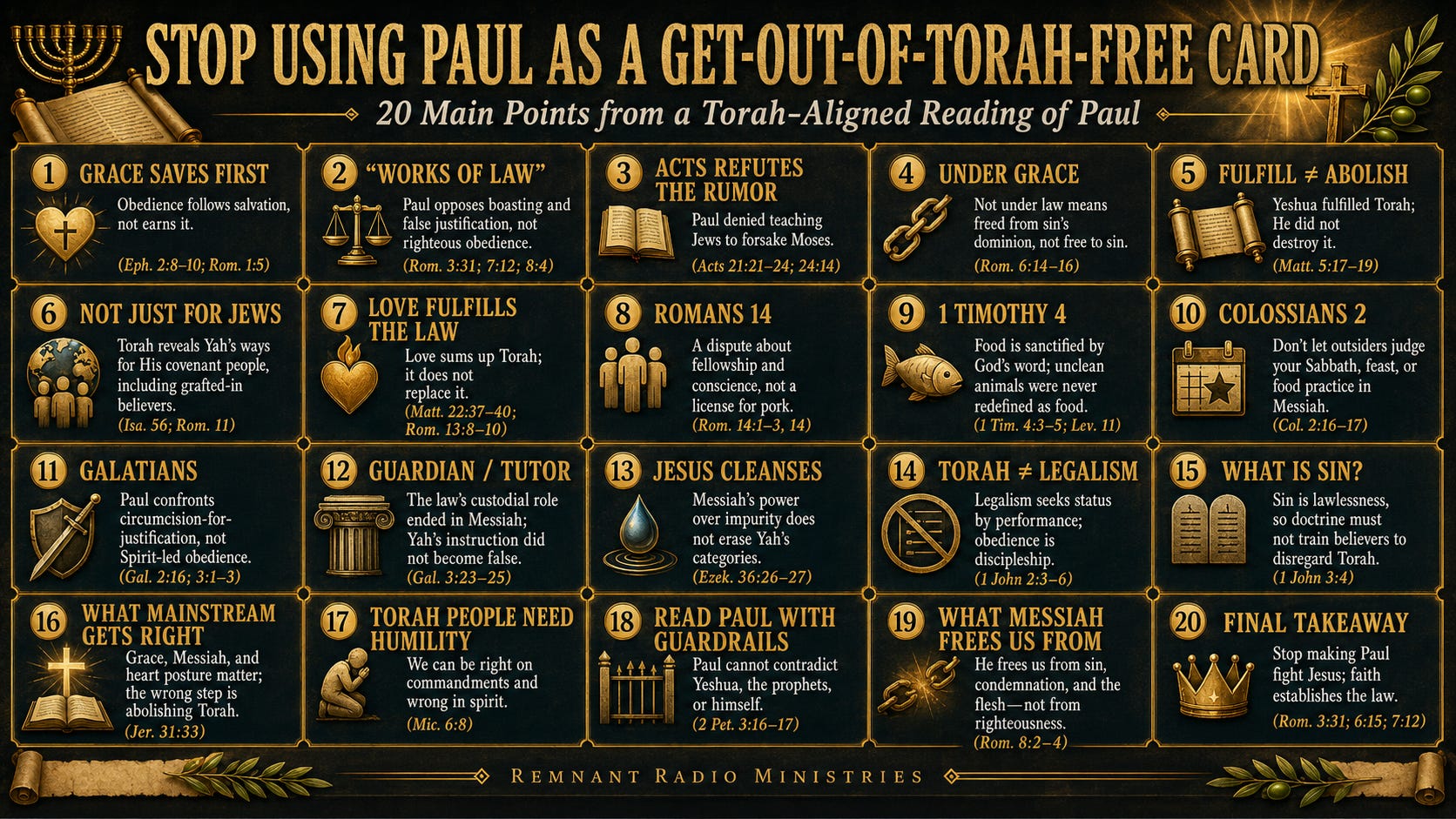
1. “Paul said we are saved by faith, not works.”
Amen. Glory to Yah. We are saved by grace through faith.
“For by grace you have been saved through faith, and that not of yourselves; it is the gift of God, not of works, lest anyone should boast.”Ephesians 2:8–9, NKJV
But the next verse matters:
“For we are His workmanship, created in Christ Jesus for good works, which God prepared beforehand that we should walk in them.”Ephesians 2:10, NKJV
Grace saves first. Obedience follows.
The problem comes when “not saved by works” becomes “obedience doesn’t matter.” Paul never teaches that. In fact, Romans begins with Paul describing his apostolic mission this way:
“Through Him we have received grace and apostleship for obedience to the faith among all nations for His name.”Romans 1:5, NKJV
That phrase is enormous: obedience to the faith among all nations.
Paul’s mission to the Gentiles was not to create a lawless faith community. It was to bring the nations into obedient allegiance to Messiah.
Bryson makes this point well: whatever Paul says later in Romans, Galatians, or elsewhere must be read through this lens. Paul is not against obedience. He is against using identity markers, circumcision, or “works of law” as the basis of justification and boasting.
That distinction changes everything.
2. “Works of the law” does not simply mean “obeying God is bad.”
One of the biggest mistakes in modern Christian interpretation is treating every negative phrase about “works” or “law” as though Paul is condemning obedience to Yah’s commandments.
But Paul himself says:
“Therefore the law is holy, and the commandment holy and just and good.”Romans 7:12, NKJV
And:
“Do we then make void the law through faith? Certainly not! On the contrary, we establish the law.”Romans 3:31, NKJV
And:
“That the righteous requirement of the law might be fulfilled in us who do not walk according to the flesh but according to the Spirit.”Romans 8:4, NKJV
So Paul cannot mean:
Faith makes Yah’s law irrelevant.
He means something closer to:
You are not justified by circumcision, ethnic status, fleshly boasting, or legalistic covenant entrance. You are justified by faith in Messiah—and that faith produces obedience from the heart.
This is why Romans 2 is so inconvenient for anti-Torah readings of Paul:
“For not the hearers of the law are just in the sight of God, but the doers of the law will be justified.”Romans 2:13, NKJV
Paul then speaks of Gentiles who show “the work of the law written in their hearts”:
“Who show the work of the law written in their hearts, their conscience also bearing witness…”Romans 2:15, NKJV
That sounds very New Covenant.
“I will put My law in their minds, and write it on their hearts…”Jeremiah 31:33, NKJV
The New Covenant does not say Yah deletes His law. It says He internalizes it.
3. Acts already settled the “Paul teaches against Moses” rumor.
This may be the most overlooked point.
In Acts 21, Paul comes to Jerusalem. James and the elders tell him that many Jewish believers are zealous for the law, but they have heard a rumor:
“You teach all the Jews who are among the Gentiles to forsake Moses, saying that they ought not to circumcise their children nor to walk according to the customs.”Acts 21:21, NKJV
Sound familiar?
That is basically the modern Christian claim:
Paul taught people to leave Moses behind.
So what happens?
Do James and Paul say, “Yes, that is exactly right. Torah is done away with now”?
No.
They instruct Paul to publicly demonstrate that the accusation is false:
“Take them and be purified with them, and pay their expenses so that they may shave their heads, and that all may know that those things of which they were informed concerning you are nothing, but that you yourself also walk orderly and keep the law.”Acts 21:24, NKJV
That is massive.
Then in Acts 24, Paul defends himself and says:
“But this I confess to you, that according to the Way which they call a sect, so I worship the God of my fathers, believing all things which are written in the Law and in the Prophets.”Acts 24:14, NKJV
So let’s be honest.
If our doctrine says Paul taught against Moses, and Acts says Paul denied that accusation, maybe the problem is not Paul.
Maybe it is our doctrine.
4. Romans 6 defines “not under law but under grace.”
This is where Bryson’s video gets especially strong.
Many Christians quote:
“For sin shall not have dominion over you, for you are not under law but under grace.”Romans 6:14, NKJV
Then they interpret it as:
We are not under law, therefore we do not need to obey Yah’s law.
But Paul explains himself in the very next verse:
“What then? Shall we sin because we are not under law but under grace? Certainly not!”Romans 6:15, NKJV
Paul could not be clearer.
“Not under law but under grace” does not mean, “Go ahead and sin.” It means sin no longer has dominion over you.
Then Paul says:
“Do you not know that to whom you present yourselves slaves to obey, you are that one’s slaves whom you obey, whether of sin leading to death, or of obedience leading to righteousness?”Romans 6:16, NKJV
There it is.
Paul’s contrast is not:
Law vs. grace means obedience vs. freedom.
Paul’s contrast is:
Sin leading to death vs. obedience leading to righteousness.
Grace does not free us to remain slaves of sin. Grace frees us from sin so we can become slaves of righteousness.
That is not legalism. That is Romans 6.
5. “Jesus fulfilled the law” does not mean “Jesus abolished the law.”
This came up repeatedly with Phil.
The common argument is:
Jesus fulfilled the law, so we do not need to keep it.
But Yeshua anticipated that misunderstanding directly:
“Do not think that I came to destroy the Law or the Prophets. I did not come to destroy but to fulfill.”Matthew 5:17, NKJV
Then He defines what He does not mean by fulfill:
“For assuredly, I say to you, till heaven and earth pass away, one jot or one tittle will by no means pass from the law till all is fulfilled.”Matthew 5:18, NKJV
Then He warns teachers:
“Whoever therefore breaks one of the least of these commandments, and teaches men so, shall be called least in the kingdom of heaven; but whoever does and teaches them, he shall be called great in the kingdom of heaven.”Matthew 5:19, NKJV
That should sober us.
Yeshua did not say:
After I fulfill the law, teach people that the lesser commandments are now irrelevant.
He said the opposite.
“Fulfill” means to fill full, embody, bring to proper meaning, accomplish what was written—not destroy.
If a husband “fulfills” his marriage vows, he does not abolish his marriage.
If a prophet “fulfills” a prophecy, the prophecy was not false; it was brought to its intended reality.
If Messiah fulfills Torah, He does not make Yah’s law bad. He reveals its fullness, embodies it perfectly, and writes it on the hearts of His people by the Spirit.
6. “The law was only for the Jews.”
This is another common argument.
Phil said, in essence:
The Mosaic Law was for Israel, to set them apart until Christ. After Christ, humanity is one under the Abrahamic covenant.
There is truth mixed in here. Torah was given to Israel. Israel was set apart. The nations were not all standing at Sinai in the same covenantal role.
But the conclusion does not follow.
First, Scripture repeatedly says the nations would eventually learn Yah’s ways:
“For out of Zion shall go forth the law, and the word of the LORD from Jerusalem.”Isaiah 2:3, NKJV
Second, the New Covenant is made with the house of Israel and Judah, yet Gentiles are grafted in through Messiah. We do not replace Israel; we join the commonwealth of Israel through covenant mercy.
“And if some of the branches were broken off, and you, being a wild olive tree, were grafted in among them…”Romans 11:17, NKJV
Third, the New Covenant promise is not, “I will write a brand-new Gentile-friendly law on their hearts.”
It says:
“I will put My law in their minds, and write it on their hearts…”Jeremiah 31:33, NKJV
The Hebrew word is Torah.
Not vibes.Not “be nice.”Not “whatever your pastor says survived Matthew 5.”
Torah.
Ezekiel says the same thing:
“I will put My Spirit within you and cause you to walk in My statutes, and you will keep My judgments and do them.”Ezekiel 36:27, NKJV
The Spirit does not cause lawlessness. The Spirit causes obedience.
7. “Jesus summarized the law as love.”
Amen.
Phil said:
“Jesus summarized the law. Love God with all your heart and your neighbor as yourself.”
True. But a summary is not an eraser.
Yeshua said:
“‘You shall love the LORD your God with all your heart, with all your soul, and with all your mind.’ This is the first and great commandment. And the second is like it: ‘You shall love your neighbor as yourself.’ On these two commandments hang all the Law and the Prophets.”**
Matthew 22:37–40, NKJV
Notice the language:
“On these two commandments hang all the Law and the Prophets.”
Hang does not mean vanish.
If I say, “My entire house hangs on the foundation,” I do not mean, “Great news, I no longer need walls, plumbing, electricity, or a roof.”
Love is the foundation, the summary, the aim, the spirit, and the proper motive of the commandments. But love does not replace Yah’s instructions. Love teaches us how to walk them rightly.
Paul says the same thing:
“Love does no harm to a neighbor; therefore love is the fulfillment of the law.”Romans 13:10, NKJV
Again, fulfillment does not mean abolition. Love fulfills the law because love does what the law was always teaching: righteousness toward Yah and righteousness toward neighbor.
John says it plainly:
“For this is the love of God, that we keep His commandments. And His commandments are not burdensome.”1 John 5:3, NKJV
That verse alone should make us pause.
Modern Christianity often says:
“We do not need commandments; we just need love.”
John says:
“This is love: keeping His commandments.”
So if our definition of love makes commandments irrelevant, we are not using John’s definition. We are using something softer, modern, and dangerously sentimental.
Yah wants our hearts, yes.
But He also wants our obedience.
And biblically, those were never supposed to be enemies.
8. “Romans 14 says we can eat whatever we want.”
This was one of Phil’s first arguments.
He wrote:
“Romans 14 1-3. Paul is pretty clear about eating whatever you want as there is no longer clean and unclean…”
Romans 14 is probably one of the most popular “pork permission slip” chapters in the modern church.
But there is one small problem:
Romans 14 never mentions pork.
It never mentions shellfish.
It never mentions Leviticus 11.
It never says, “Yah’s clean and unclean food categories are now abolished.”
Paul’s actual example is this:
“For one believes he may eat all things, but he who is weak eats only vegetables.”Romans 14:2, NKJV
That is not a clean/unclean animal debate.
That is a meat vs. vegetables debate.
In the first-century world, that kind of discussion usually points to concerns about marketplace meat, idol contamination, uncertain slaughter, fasting, asceticism, or conscience—not whether Yah suddenly reclassified pigs, vultures, rats, and shrimp as covenant food.
Paul’s concern in Romans 14 is not:
“Good news, Leviticus was wrong.”
His concern is:
“Do not destroy your brother over disputable fellowship issues.”
He says:
“Let us not judge one another anymore, but rather resolve this, not to put a stumbling block or a cause to fall in our brother’s way.”Romans 14:13, NKJV
And:
“Do not destroy the work of God for the sake of food.”Romans 14:20, NKJV
That is fellowship language. Conscience language. Stumbling-block language.
It is not a formal repeal of Yah’s dietary instruction.
Paul has a similar discussion in 1 Corinthians 8–10, where the issue is food sacrificed to idols, conscience, knowledge, liberty, and love. Again, he is not abolishing Torah. He is teaching believers how to walk wisely in mixed communities with different backgrounds and sensitivities.
So yes, Romans 14 matters.
But if someone uses Romans 14 to erase Leviticus 11 without Paul ever naming Leviticus 11, that is not exegesis.
That is bringing a theological coupon to a grocery store that does not accept it.
9. “1 Timothy 4 says everything God created is good.”
Phil also raised another common argument:
“First 1 Timothy 4 everything God created is good receive it with thanks.”
This is another verse that gets quoted as though Paul said:
“Everything with a pulse is now dinner.”
But Paul’s actual words are more specific:
“For every creature of God is good, and nothing is to be refused if it is received with thanksgiving; for it is sanctified by the word of God and prayer.”1 Timothy 4:4–5, NKJV
That last phrase is critical:
“sanctified by the word of God”
Paul does not say food is sanctified by appetite.
He does not say food is sanctified by culture.
He does not say food is sanctified by “well, Lord, bless this questionable gas station shrimp.”
He says it is sanctified by the word of God and prayer.
So the Torah-aligned response is simple:
Everything God created is good, but not everything God created is food.
Vultures are good.
Rats are good.
Pigs are good.
Lobsters are good.
Bats are good.
They all have a purpose in creation. But the question is not whether they are “good” in a Genesis 1 sense. The question is whether Yah gave them to His people as food.
Leviticus 11 and Deuteronomy 14 define food categories for Yah’s covenant people. Paul is not contradicting that. He is opposing ascetic doctrines that forbid foods God actually created to be received with thanksgiving.
There is a difference between rejecting food Yah permitted and declaring food what Yah did not.
One is man-made restriction.
The other is man-made permission.
Both can be rebellion if they ignore Yah’s word.
10. “Colossians 2 says don’t let anyone judge you about Sabbaths, feasts, or food.”
Phil later quoted Colossians 2:
“So why would you allow anyone to judge you because of what you eat or drink, or insist that you keep the feasts, observe new moon celebrations, or the Sabbath? All of these were but a prophetic shadow…”
This is one of the heavyweight prooftexts used against Sabbath, feasts, and Torah practice.
But again, context matters.
Paul says:
“So let no one judge you in food or in drink, or regarding a festival or a new moon or sabbaths, which are a shadow of things to come, but the substance
belongs to Christ.”Colossians 2:16–17, NKJV
Notice what Paul does not say.
He does not say:
“Therefore, stop keeping Sabbaths.”
He does not say:
“Therefore, stop honoring Yah’s appointed times.”
He does not say:
“Therefore, the feasts were pagan, pointless, or abolished.”
He says:
“Let no one judge you.”
That means the question is not merely, “Are Sabbaths and feasts mentioned?”
The question is:
Who is judging whom, and why?
Colossians 2 is full of warnings about human philosophy, man-made rules, asceticism, false humility, angel worship, and self-imposed religion:
“Beware lest anyone cheat you through philosophy and empty deceit, according to the tradition of men…”Colossians 2:8, NKJV
And later:
“Therefore, if you died with Christ from the basic principles of the world, why, as though living in the world, do you subject yourselves to regulations—‘Do not touch, do not taste, do not handle,’ which all concern things which perish with the using—according to the commandments and doctrines of men?”Colossians 2:20–22, NKJV
So the context is not:
Moses vs. Jesus.
The context is:
man-made religious judgment vs. Messiah.
Paul is warning believers not to let others judge them by human religious standards regarding food, drink, festivals, new moons, and Sabbaths.
And yes, he says these things are a shadow.
But since when is a shadow bad?
A shadow tells you something real is casting it.
Passover points to Messiah.
Unleavened Bread points to removing sin.
Firstfruits points to resurrection.
Shavuot/Pentecost points to covenant giving and Spirit empowerment.
Trumpets points to awakening, warning, and the King’s return.
Atonement points to judgment, cleansing, and priestly intercession.
Tabernacles points to Yah dwelling with His people and the coming Kingdom.
Sabbath points backward to creation, backward to redemption, and forward to the rest that remains for the people of God.
A shadow is not the enemy of the body. A shadow is evidence that the body is there.
So why would we despise shadows that Yah Himself gave, especially when they point to Messiah?
Paul’s point is not:
“Let no one judge you because you stopped keeping Yah’s calendar.”
It may be closer to:
“Let no one judge you as you keep these things in Messiah, free from man-made rules, ascetic distortions, and human traditions.”
The feasts are not empty when Messiah is at the center.
They are prophetic rehearsals.
They are Kingdom reminders.
They are Yah’s calendar preaching the gospel on repeat.
11. “The law was our guardian until Christ.”
This was another one Phil raised from Galatians 3:
“The law was our guardian until Christ came… now that the way of faith has come, we no longer need the law as our guardian.”
That is a real verse and it matters.
Paul writes:
“Therefore the law was our tutor to bring us to Christ, that we might be justified by faith. But after faith has come, we are no longer under a tutor.”Galatians 3:24–25, NKJV
Amen.
The Torah exposes sin. It teaches righteousness. It shows us our need for Messiah. It guards and instructs. But it cannot justify us apart from faith. It cannot give life to the spiritually dead. It cannot cleanse the conscience by itself. Messiah does what Torah pointed toward.
But here is the key:
A tutor finishing one role does not make the tutor’s instruction false.
If a child learns math from a tutor, graduates, and becomes an engineer, he does not say:
“Great news. Two plus two has been abolished.”
The tutor’s custodial function changed. The truth taught did not become false.
Galatians is not saying:
“Yah’s commandments are now bad.”
Paul would never say that. Again:
“Therefore the law is holy, and the commandment holy and just and good.”Romans 7:12, NKJV
Galatians is dealing with a specific crisis: Gentile believers were being pressured to undergo circumcision as a requirement for covenant status and justification.
That is why Paul says:
“Indeed I, Paul, say to you that if you become circumcised, Christ will profit you nothing.”Galatians 5:2, NKJV
He is not talking about someone obeying Yah from the heart after salvation. He is confronting a false gospel that says Gentiles must enter through fleshly conversion and circumcision to be justified.
This is exactly why Bryson Gray’s distinction matters: Paul is not attacking obedience. He is attacking false justification.
Or to say it simply:
Paul is not against Torah.Paul is against using Torah unlawfully.
And Paul says the same elsewhere:
“But we know that the law is good if one uses it lawfully.”1 Timothy 1:8, NKJV
That little phrase deserves to be written in bold on the front of every study Bible:
The law is good if one uses it lawfully.
So yes, the law was a tutor to bring us to Messiah.
But Messiah does not graduate us into disobedience.
He graduates us into Spirit-led maturity.
12. “The moral law remains, but the Mosaic law is gone.”
This is perhaps the most popular modern theological compromise.
Phil said something like:
“I think you might be confused between the Moral Law—the Ten Commandments—and the rules God gave the Israelites. The Mosaic Law was for a time. After Christ, He summarizes the moral code as love God and love others.”
This sounds reasonable because Christians instinctively know they cannot say all commandments are gone.
Nobody wants to say murder is fine now.
Nobody wants to say adultery is sanctified now.
Nobody wants to say idolatry is just “Christian liberty.”
So a new category system gets created:
Moral law stays.Ceremonial law goes.Civil law was only for Israel.
Now, I understand why people use those categories. They can be helpful descriptively. Some commandments deal with priesthood. Some deal with courts. Some deal with moral behavior. Some deal with food. Some deal with the land. Some deal with festivals.
But Scripture does not give us permission to use those categories as a delete button.
Yeshua did not say:
“Do not think I came to destroy the moral law, but the ceremonial and dietary parts are definitely going down.”
He said:
“Do not think that I came to destroy the Law or the Prophets.”Matthew 5:17, NKJV
The whole thing.
He then warned against teaching even the least commandments as disposable.
So here is the problem:
If we divide Yah’s commandments into categories and then use those categories to abolish whatever modern Christianity finds inconvenient, we are no longer submitting to Scripture.
We are managing Scripture.
We are acting like Yah gave us a holy filing cabinet and asked us to label one drawer “eternal” and another drawer “expired.”
But Yah never said:
“Here are My temporary Jewish rituals; feel free to ignore them once you discover bacon-wrapped scallops.”
He said His commandments are righteousness.
“My tongue shall speak of Your word, for all Your commandments are righteousness.”Psalm 119:172, NKJV
Not some.
All.
That does not mean every commandment applies the same way in every circumstance. There is no standing Levitical temple operating in Jerusalem right now. I am not a Levitical priest. I cannot carry out priestly altar duties in my backyard and call it obedience.
Application requires wisdom.
But “I cannot apply this commandment in the same way right now” is very different from “Yah abolished it.”
Torah is not dead.
Some commandments await proper jurisdiction, priesthood, land, temple, or Kingdom context.
Some are immediately applicable in daily discipleship.
Some teach wisdom, holiness, justice, and prophetic patterns.
But none of Yah’s Word is trash.
13. “Jesus made everything clean.”
Phil also said, in essence:
“It is only the blood of Jesus that makes us clean.”
Amen and amen.
Only Messiah cleanses us from sin.
But that truth does not prove that all Torah categories of clean and unclean vanished.
Yeshua touched lepers and cleansed them.
That does not mean leprosy was never unclean.
Yeshua touched the dead and raised them.
That does not mean death is no longer an enemy.
Yeshua forgave sinners.
That does not mean sin stopped being sin.
Messiah has authority over impurity, sickness, demons, sin, and death. But His authority over those things does not redefine rebellion as righteousness.
This is where intention matters.
Yah does not want robotic law-keeping.
He wants circumcised hearts.
But the modern mistake is assuming that because Yah wants the heart, He no longer cares about the walk.
Scripture says the opposite:
“I will give you a new heart and put a new spirit within you… I will put My Spirit within you and cause you to walk in My statutes, and you will keep My judgments and do them.”Ezekiel 36:26–27, NKJV
New heart.
New Spirit.
Actual walking.
The Spirit does not replace obedience with sentiment. The Spirit empowers obedience from the inside out.
14. “But isn’t Torah obedience legalism?”
It can be.
Anything can be corrupted.
Prayer can become legalism.
Fasting can become legalism.
Bible reading can become legalism.
Church attendance can become legalism.
Giving can become legalism.
Evangelism can become legalism.
Even saying “I’m not legalistic” can become legalism if we become proud of our supposed freedom.
Legalism is not obedience.
Legalism is trying to earn justification, status, or superiority through performance.
Biblical obedience is different.
Biblical obedience says:
“I am saved by grace. Yah has redeemed me. Messiah is my King. His Spirit is in me. His Word is good. I want to walk as He walked.”
John says:
“Now by this we know that we know Him, if we keep His commandments.”1 John 2:3, NKJV
And:
“He who says he abides in Him ought himself also to walk just as He walked.”1 John 2:6, NKJV
That is not legalism.
That is discipleship.
Legalism says:
“I obey so God will save me.”
Faith says:
“God saved me, so teach me to obey.”
Huge difference.
One is flesh.
The other is fruit.
15. The real issue: what is sin?
This is the question underneath the whole debate.
If sin is just “whatever feels unloving to me,” then Torah becomes optional.
If sin is “whatever my church tradition still recognizes,” then Torah gets edited by denomination.
If sin is “whatever the Holy Spirit personally convicts me of,” then morality becomes dangerously subjective.
But Scripture gives a definition:
“Whoever commits sin also commits lawlessness, and sin is lawlessness.”1 John 3:4, NKJV
Sin is lawlessness.
That does not mean every person has equal knowledge, equal maturity, or equal accountability in every moment. Yah is merciful, patient, and just.
But it does mean that if our doctrine trains people to disregard Yah’s law, we are not merely having a “secondary issue” conversation.
We are talking about the definition of sin.
This is why Peter’s warning matters.
If people twist Paul into lawlessness, they are not merely misreading a footnote.
They are redefining discipleship.
They are redefining sin.
They are redefining grace.
And that is dangerous.
16. What Phil gets right
To be fair, Phil gets several things right.
He is right that we are saved by grace through faith.
He is right that Messiah is central.
He is right that the blood of Yeshua cleanses us.
He is right that the law cannot justify us apart from Messiah.
He is right that love is the great commandment framework.
He is right that we should search Scripture, not just follow teachers.
He is right that heart posture matters.
Where I believe mainstream doctrine goes wrong is in taking those true statements and then drawing an unbiblical conclusion:
Therefore, Yah’s Torah is no longer binding instruction for believers.
That conclusion does not follow.
The better conclusion is:
Therefore, Yah’s Torah must be understood through Messiah, applied by the Spirit, guarded from legalism, and lived out as fruit—not as a means of earning salvation.
That is a very different doctrine.
17. What Torah-aligned believers must also remember
Now let me turn the mirror around.
Torah-aligned believers can be right on Torah and wrong in spirit.
We can win the argument and lose the brother.
We can quote Matthew 5:17–19 and still fail Matthew 22:37–40.
We can keep Sabbath and break peace.
We can avoid pork but devour one another.
We can study commandments and become arrogant.
That is not Torah written on the heart.
That is just another version of flesh wearing Hebrew vocabulary.
Yah wants obedience and heart.
He wants truth and love.
He wants commandments and mercy.
He wants zeal and humility.
As Micah says:
“He has shown you, O man, what is good; and what does the LORD require of you but to do justly, to love mercy, and to walk humbly with your God?”Micah 6:8, NKJV
So no, Torah obedience is not a license to become smug.
If your Torah makes you cruel, you are doing it wrong.
If your grace makes you lawless, you are doing it wrong.
If your love makes you allergic to commandments, you are doing it wrong.
And if your commandments make you allergic to love, you are also doing it wrong.
18. The guardrails for reading Paul rightly
Here are the guardrails I am trying to keep in place.
Paul cannot contradict Yeshua.
If my interpretation of Paul makes Matthew 5:17–19 meaningless, my interpretation of Paul is wrong.
Paul cannot contradict the prophets.
If my interpretation of Paul says the New Covenant erases Torah, while Jeremiah says Yah writes Torah on the heart, my interpretation of Paul is wrong.
Paul cannot contradict himself.
If my reading of Romans 6 says grace allows sin, while Romans 6 says grace frees us from sin, my reading is wrong.
Paul cannot be used to defend lawlessness.
Peter specifically warned against that.
Faith cannot be separated from obedience.
Abraham believed Yah, and his faith moved.
James says:
“Was not Abraham our father justified by works when he offered Isaac his son on the altar? Do you see that faith was working together with his works, and by works faith was made perfect?”James 2:21–22, NKJV
James is not contradicting Paul.
James is correcting the same false idea we are dealing with now:
faith as mere belief without obedience.
Even demons believe.
They are not disciples.
19. So what did Messiah actually free us from?
This is where the conversation should land.
Messiah did not free us from righteousness.
He freed us from sin.
He did not free us from Yah’s wisdom.
He freed us from condemnation.
He did not free us from obedience.
He freed us from slavery to the flesh.
He did not free us from the law written on the heart.
He freed us from the law of sin and death.
Paul says:
“For the law of the Spirit of life in Christ Jesus has made me free from the law of sin and death.”Romans 8:2, NKJV
And then he says the righteous requirement of the law is fulfilled in those who walk according to the Spirit:
“That the righteous requirement of the law might be fulfilled in us who do not walk according to the flesh but according to the Spirit.”Romans 8:4, NKJV
That is the New Covenant.
Not Torah thrown in the trash.
Torah fulfilled in Spirit-led people.
20. Final word: stop making Paul fight Jesus
If there is one thing I wish every believer would stop doing, it is this:
Stop making Paul fight Jesus.
Stop quoting Paul as if he came to rescue us from the Sermon on the Mount.
Stop quoting Paul as if he corrected Moses.
Stop quoting Paul as if “grace” means Yah lowered His standards.
Stop quoting Paul as if Peter did not warn us this exact twisting would happen.
Paul is not the apostle of lawlessness.
Paul is the apostle of Messiah-centered, Spirit-empowered, obedience-producing faith among the nations.
That is why he can say:
“Do we then make void the law through faith? Certainly not! On the contrary, we establish the law.”Romans 3:31, NKJV
That is why he can say:
“The law is holy, and the commandment holy and just and good.”Romans 7:12, NKJV
That is why he can say:
“Shall we sin because we are not under law but under grace? Certainly not!”Romans 6:15, NKJV
And that is why Peter tells us to beware of people who twist Paul into lawlessness.
Phil and I may not agree yet. But I’m planting seeds, and praying Yah opens his eyes and heart to his torah.
I also love him and I honor him as a brother. And I believe the conversation matters because this is not ultimately about winning a debate.
It is about being found by Messiah as Peter said:
“Therefore, beloved, looking forward to these things, be diligent to be found by Him in peace, without spot and blameless.”2 Peter 3:14, NKJV
Spotless.
Blameless.
In peace.
Not saved by law-keeping.
Not lawless under grace.
But redeemed by Messiah, filled with the Spirit, and learning to walk in the ancient paths of Yah.
Because the narrow way was never supposed to be a theological loophole.
And Paul was never meant to be our get-out-of-Torah-free card.
He was warning us how to stop being slaves to sin.
So maybe the real question is not:
“Do I have to obey?”
Maybe the better question is:
“If Yah has redeemed me, filled me with His Spirit, and written His Torah on my heart… why would I not want to follow Him and walk as He walked?”